Thomas Baumann, Installation Wak, 2020
Foto: Johannes Stoll / Belvedere, Wien
Thomas Baumann, Wak, 2020
In the elongated water basin of the sculpture garden, a computer-controlled mechanism is programmed to generate artificial waves at regular intervals. Thomas Baumann refers to his work Wak as a kinetic sculpture, the original poetic idea being the desire to “invent a miniature sea.” In this way, he simulates a natural phenomenon in the urban space, wherein the real main feature is the wild force of nature – both captivating and disturbing at once.
More
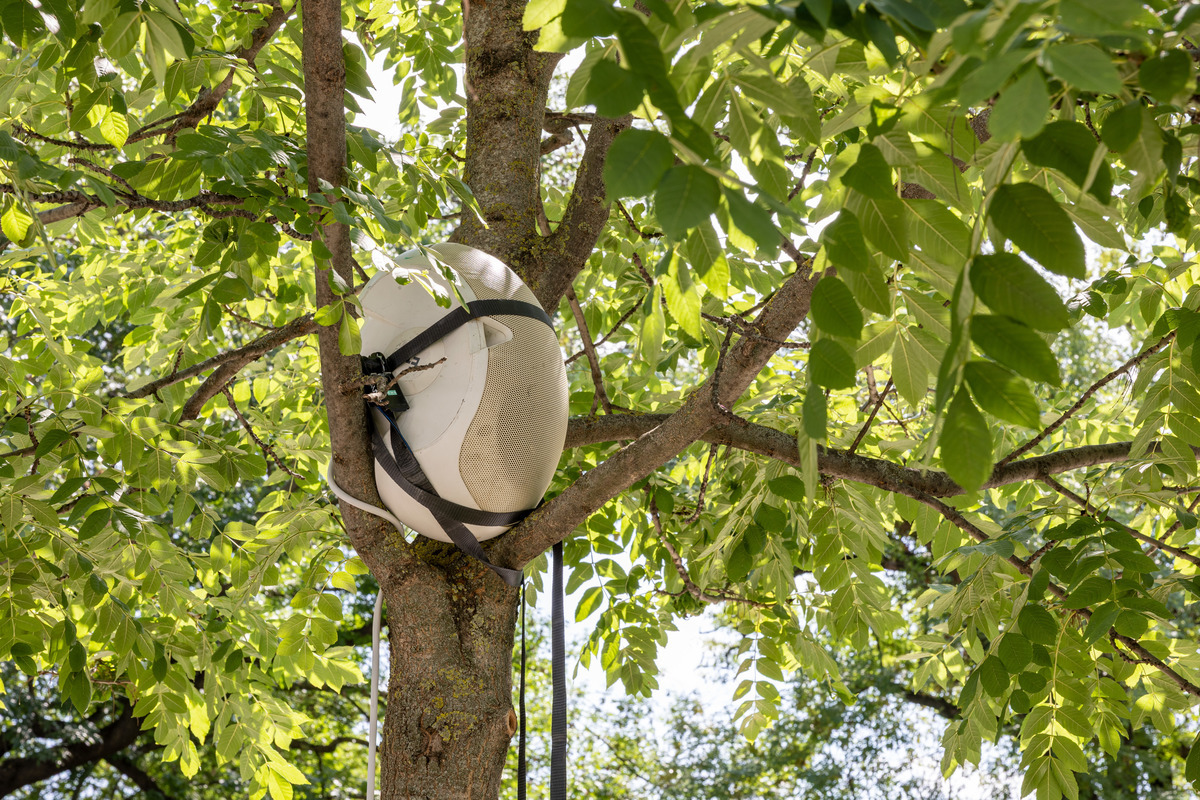
Jasmina Cibic, Dawn Chorus, 2024
Photo: Johannes Stoll / Belvedere, Vienna
Jasmina Cibic, Dawn Chorus, 2024
In her sound installation Dawn Chorus—created specifically for the Belvedere 21 sculpture garden—Jasmina Cibic refers to the Non-Aligned Movement, founded in former Yugoslavia in 1961. Sound recordings of birds from these countries—which are also the countries of origin for most unaccompanied minor refugees in Austria—interweave a historical geopolitical order with contemporary migration and displacement. Drawings of these bird species, named after European researchers, colonial officials, and missionaries, further highlight the continued presence of colonial systems of knowledge and classification.
More
VALIE EXPORT, The Doppelgänger, 2010
Photo: Johannes Stoll / Belvedere, Vienna
VALIE EXPORT, The Doppelgänger, 2010
Two pairs of scissors interlocked to form a single figure: the scissor dancers, as the feminist artist called them, served as an advertising theme for the Tanzquartier Wien in 2009. The act of cutting “into one’s flesh” is also present in EXPORT’s early videos and performances. There, the act of cutting is often used to signify the way in which social norms inscribed on the female body cause psychological harm. In this context, the scissors can also be seen as a reference to the domestic tasks typically associated with women.
More
Roland Goeschl, Column Formation, c. 1979
Photo: Johannes Stoll / Belvedere, Vienna
Roland Goeschl, Column Formation, c. 1979
“Everyone can build their own color space.” Roland Goeschl’s motto from 1968 can also be applied to this column formation. Its defining characteristics are the geometric shapes and the primary colors red, blue, and yellow. By rotating the shapes to equal degrees around their shortest side, the artist lends dynamism to the otherwise static solid figures, encouraging the viewer to actively explore the monumental object in its spatial setting – as if the cubes were calling on the viewer to rearrange them.
More
Hans Haacke, Gift Horse 2014
Photo: Johannes Stoll / Belvedere, Vienna
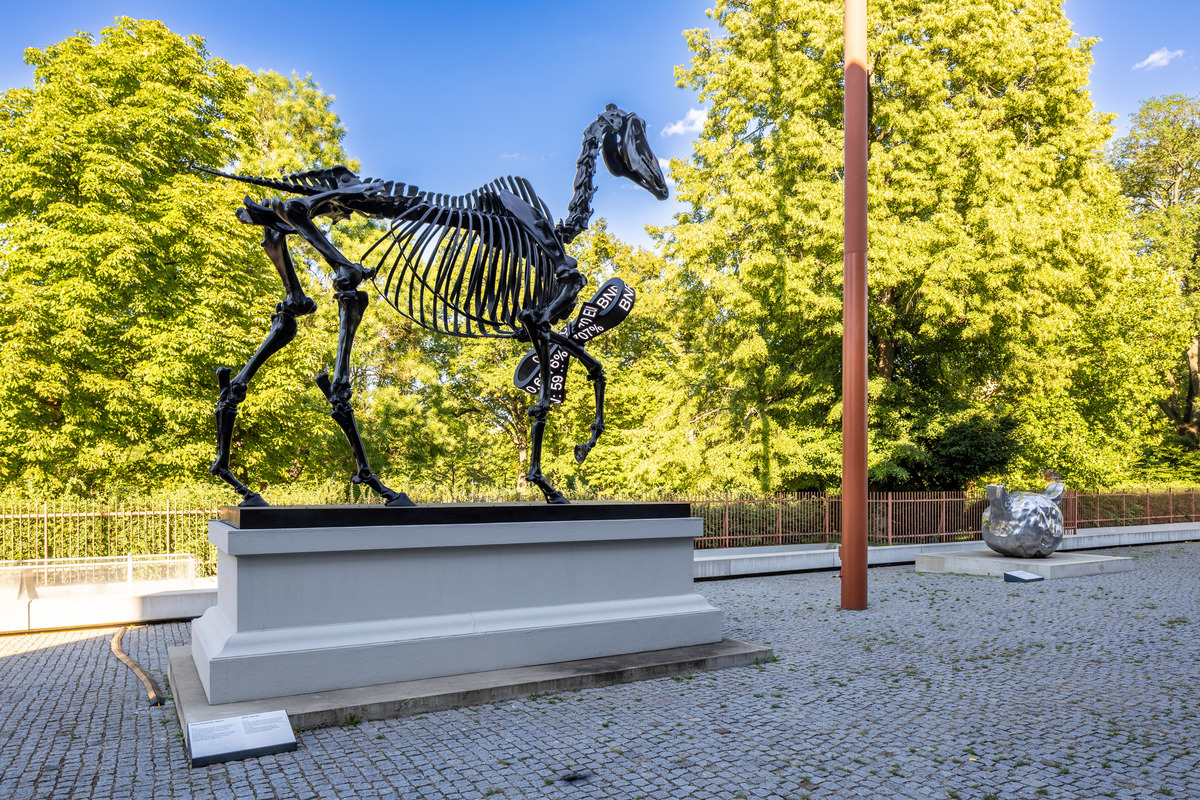
Hans Haacke, Gift Horse, 2014
Hans Haacke created this monumental bronze skeleton of a horse as part of the ‘Fourth Plinth Programme’ in London’s Trafalgar Square. Its scale corresponds to the horse in the neighboring equestrian statue of George IV. A bow is tied around one of the front legs, as if it were a gift; its electronic displays once showed the FTSE 100 Index in London and now display data from the Vienna Stock Exchange. Conceived as a counter-monument, Gift Horse exposes the historical entanglements of capital, power, and representation—and their continuing impact on the present.
More
Hans Kupelwieser, e 14/1 sculptor, 2014
Foto: Johannes Stoll / Belvedere, Wien
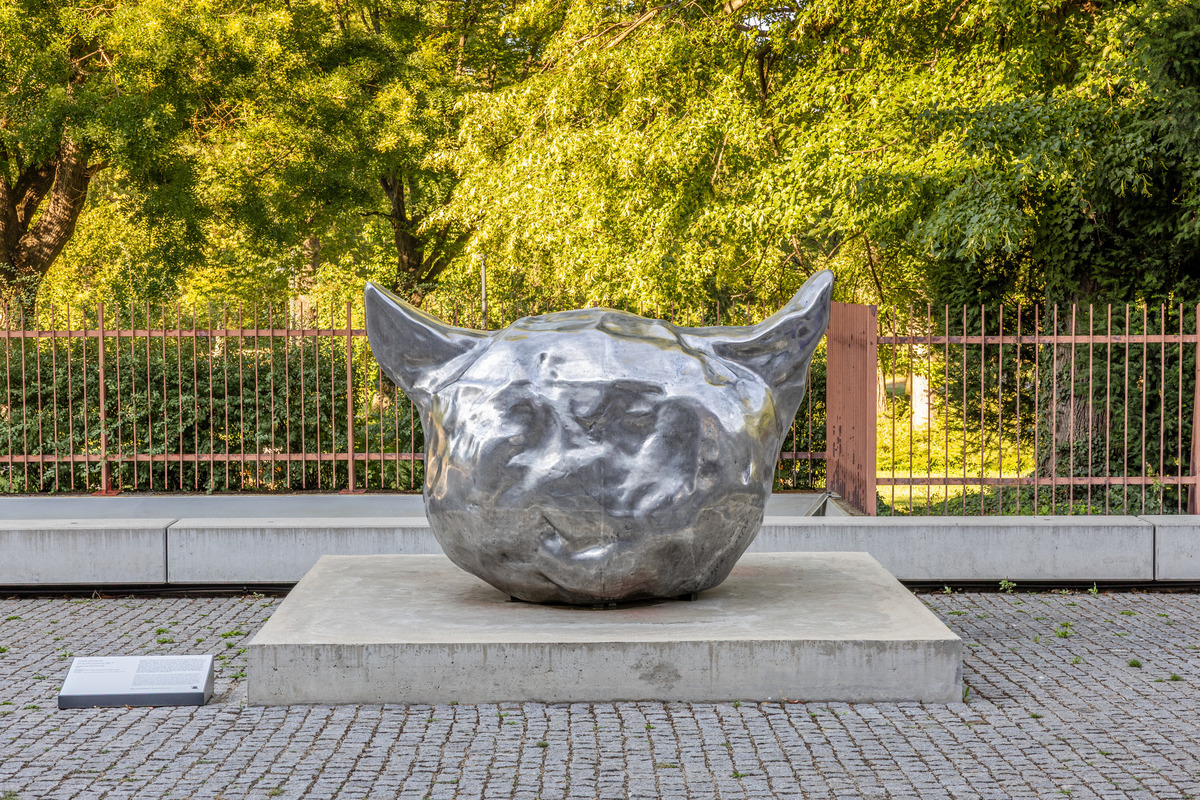
Hans Kupelwieser, e 14/1 sculptor, 2014
The sculpture captivates with its multiple perspectives, an effect magnified by its irregular shape and reflective surface. The reflection also has a contextual dimension, encouraging contemplation from all angles. The material properties of the metal are thwarted: what is reminiscent of crumpled paper weighs 270 kilograms. The crushing process involves the use of an excavator, introducing a level of unpredictability to the outcome. This principle of guided chance is a defining feature of Hans Kupelwieser’s approach.
More
Kris Lemsalu, Chará, 2023
Photo: Johannes Stoll / Belvedere, Vienna
Kris Lemsalu, Chará, 2023
Themes of birth, rebirth, renewal, and the fountain of youth emerge throughout Kris Lemsalu’s work. The figure of Chará draws upon popular culture and mythology and conveys a personal story. The image of a heart, a vagina dentata (toothed vagina), and a portal emerge from playing with the shape of a reindeer jaw. The word “chará” is of ancient Greek origin and translates to “joy.” The artist aims to convey that joie de vivre and cheerfulness are essential aspects of life.
Sarah Ortmeyer, DIABOLUS (PROTECTOR), 2020
Photo: Johannes Stoll / Belvedere, Vienna © Bildrecht, Vienna 2026
Sarah Ortmeyer, DIABOLUS (PROTECTOR), 2020
Sarah Ortmeyer’s work moves between sculpture and painting. DIABOLUS (PROTECTOR), from the EMOJI SHADOW Series, transforms the familiar silhouette of a digital icon into a three-dimensional figure. In many cultures, devils and demons have been regarded not only as threatening but also as protective beings. Ortmeyer draws on this ambiguity: the flat, standardized symbol becomes an autonomous presence that reveals good and evil not as opposites but as interconnected forces.
More
Maruša Sagadin, B-Girls, Go!, 2018
Foto: Johannes Stoll / Belvedere, Wien
Maruša Sagadin, B-Girls, Go!, 2018
The oversized pink baseball cap is a reference to hip-hop and street culture – key reference points for Maruša Sagadin, whose sculptural and architectural work is shaped by her engagement with pop culture, gender, and language. B-Girls, Go! creates a kind of stage for girls, women, and those who identify as female. The participatory sculpture provides a venue for community activities, a meeting point, and place to linger.
More
Lois Weinberger, Wayside House, 2019/2021
Photo: Johannes Stoll / Belvedere, Vienna
Lois Weinberger, Wayside House, 2019/2021
Lois Weinberger’s work explores the concept of “wilderness” as it is shaped by cultural influences and the role of architecture in this context. In Greece, he came across roadside houses, which not only serve as memorials to accident victims but also store provisions for wayfarers. The Wayside House is painted red and dedicated to poppies. Notes with poems by the artist can be stamped and taken away – an allusion to hiking passbooks that document the distances traveled.
More
Lois Weinberger, Wild Cube, 2011
Foto: Johannes Stoll / Belvedere, Wien
Lois Weinberger, Wild Cube, 2011
Inside a giant steel cage, various plants are growing rankly and out of control, their branches reaching out from between the iron bars. As the seasons change, the Wild Cube reveals the constant cycle of nature’s growth and decay; the cage does not confine nature instead it excludes people. In this work, as in his other artistic endeavors, Lois Weinberger explores the idea of artwork as a living organism that continually surpasses the limits set by humans.
More
Fritz Wotruba, Large Figure Relief, 1957/58
Photo: Johannes Stoll / Belvedere, Vienna
Fritz Wotruba, Large Figure Relief, 1957/1958
The human figure is the focus of Fritz Wotruba’s sculptural oeuvre, which becomes increasingly abstract and reduced to blocks or cylindrical forms. In 1957 Wotruba was commissioned to create a relief to be placed at ground level in front of the façade of the Austrian Pavilion, which was designed by Karl Schwanzer for the 1958 World’s Fair in Brussels. The seven figures emerging from or merging with the relief’s sections intermingle with the visitors.
More
Heimo Zobernig, Untitled, 2013
Photo: Johannes Stoll / Belvedere, Vienna
Heimo Zobernig, Untitled, 2013
In 2013, Heimo Zobernig realized an intervention with five concrete platforms arranged in a stage-like configuration. The installation references the overall architectural design of the Belvedere 21 building and can serve as a base for sculptures, a performance space, or be left empty. Zobernig’s intervention is open to multiple interpretations and uses, defying precise categorization. It encourages viewers to rethink their perception of sculpture.
More