

Future Traces: From Game Jam to Museum Game
How a 48-Hour Prototype Became Part of the Belvedere 21 Experience
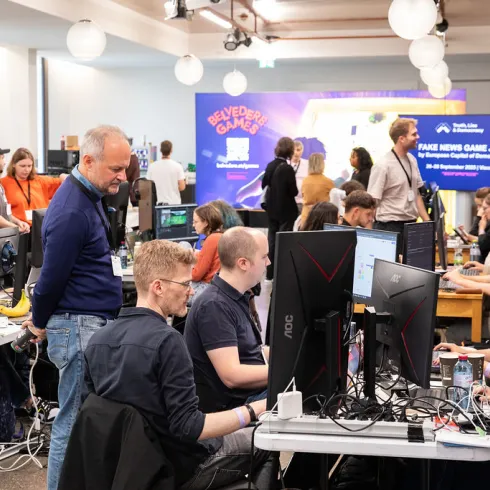
Two years ago, Raffael Moser slept under a table at Belvedere 21 during a game jam.
Not because he couldn’t find a better spot, but because every minute counted. Together with Melanie Bartl and Paula Langthaler, he had only 48 hours to turn an idea into a working game.
Today, visitors can experience this very game for themselves.
Lisa Ebner-Kollmann
© Belvedere, Wien
Future Traces guides visitors through the sculpture garden at Belvedere 21 and shows how a spontaneous idea can, step by step, evolve into an interactive museum experience. However, at the #1 Culture Game Jam Vienna 2024 – organized by Change Tourism Austria (CTA) in cooperation with the Belvedere – it was anything but a given that this would one day become a finished museum game.
What is Future Traces?
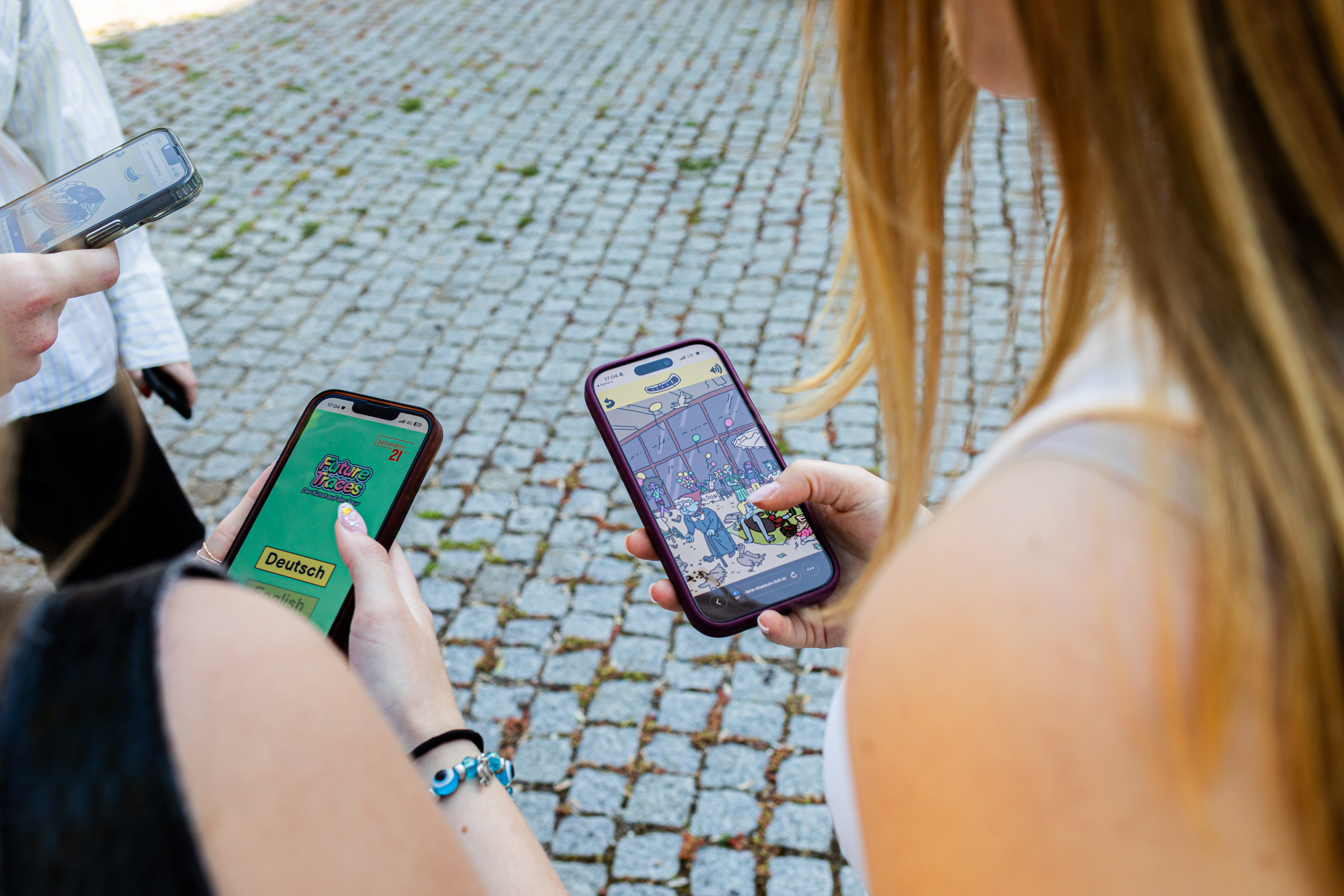
"Future Traces. Tracking down art" is a free, browser-based game for smartphones. By scanning a QR code, visitors are transported directly into an interactive adventure – without having to download an app.
The game centers on Vio, a time traveler from the future. After a crash-landing in the sculpture garden, Vio’s time machine needs new energy. The only way to recharge it is by discovering sculptures, solving little puzzles, and learning about Vio’s stories along the way.
What initially seems like a classic hidden-object game quickly evolves into a playful journey of discovery through the sculpture garden.
"We’re making a hidden-object game."
It all began with that sentence.
“I was the one with the idea: ‘Let’s make a hidden object game,’” recalls Melanie Bartl.
However, it wasn’t meant to be an ordinary hidden-object game. Instead of a static scene, the team developed a 360-degree panorama in which players can look around freely.
The inspiration was right on their doorstep.
Melanie photographed the sculpture garden with her smartphone and used the panorama as the basis for the subsequent illustration. Little by little, the real-life location transformed into a drawn world – full of little stories and details.
“The artworks are intentionally placed in the wrong spots throughout the game,” she explains. “That's part of what makes the game so engaging.”
It’s precisely this combination of reality and fiction that gives Future Traces its unique character.

48 hours
Game jams follow their own rules. Within just two days, an initial idea is turned into a playable prototype. There’s hardly any time for long discussions.
“You have to make decisions, solve problems, and work very closely together as a team,” says Raffael Moser. “It’s always a very intense, but also very inspiring time.”
And sometimes that even means spending the night under a table.
“The biggest challenge? Sleeping on the floor,” he says with a laugh. “We were there nonstop for 48 hours.”
At the time, no one knew that this particular prototype would later be further developed.

Why this game in particular?
The #1 Culture Game Jam Vienna spawned numerous exciting ideas. Many of these prototypes are still playable today on itch.io and are regularly showcased in person at open-house events in the Belvedere Game Lounge. Future Traces, however, caught the jury's attention in a special way.
“I’m always thrilled when something I originally perceive as analog – like a hidden-object game – fits quite naturally into a digital environment,” says Michaela Höß, Head of Art Education at the Belvedere.
There was also a second factor: the game didn’t simply turn works of art into objects, but into characters in a story. Players encounter them, discover their backstories, and engage with them in a playful way.
This was where the Belvedere saw the prototype's potential and decided to continue developing it together with the team.
From a Prototype to a Project
The work didn’t end with the Game Jam – it was just beginning.
An idea that had emerged in just 48 hours evolved into a joint development project between the Belvedere and a team of independent developers, who came together in 2024 under the name “Minimal Temperature Egg” for the #1 Culture Game Jam Vienna at Belvedere 21. The project’s further development was coordinated by project coordinator Simon Schneider, who guided the transition from the original game jam prototype to the finished game.
In their day-to-day lives, they all work independently in their own companies: Sappalot Studios, Flathead Studios, and Poppysounds. Collaborating with a museum was a new experience for each of them.
“I was surprised by how many different perspectives come together in a project like this,” says Raffael Moser.
“It’s not just about the game itself. You have to think about how content is conveyed, whose voices are included, and how it all fits together.”
Raffel Moser
For the development team, this meant numerous coordination meetings and feedback loops with the Belvedere. For the Belvedere, in turn, it was an opportunity to closely integrate game design and art education.
“We need this game development expertise in-house,” says Michaela Höß. “At the same time, it’s always about finding the right balance: How much content does the game need – and how much gameplay does the content need?”
It is precisely this balance that defines Future Traces. Instead of simply explaining art, the game invites players to discover it for themselves. .
The moment when everything comes together
For Melanie Bartl, a game begins with a creative question: What does this world actually look like? Colors, shapes, and illustrations determine the character a game will eventually take on.
For Paula Langthaler, however, the decisive moment doesn’t come until image and sound come together. “Then you suddenly realize: This works together.”
“All of a sudden, the game is fun. It looks nice, it sounds like something. That’s always a huge morale boost.”
With Open Eyes
Of course, Future Traces conveys knowledge about the sculptures at Belvedere 21. But the game does more than simply impart knowledge. It invites players to look more closely, discover connections, and not just view art, but actively explore it.
For developer Raffael Moser, this was a central concern. Future Traces is designed to spark visitors’ curiosity – both about the stories behind the sculptures and about the many objects they encounter every day outside the museum. Art thus becomes the starting point for a more attentive view of one’s own surroundings.
Michaela Höß also sees games as an additional means of art education. They do not replace traditional formats but complement them with a playful approach that can bring people into contact with art in a different way.
Two years ago, Future Traces was created in 48 intense hours during a game jam. Today, the game guides visitors through the sculpture garden of Belvedere 21. The long journey in between – from the first sketches through illustrations and sound to countless conversations and lines of code – remains invisible while playing. Yet it is precisely this invisible process that turned an idea into an experience that invites others to explore.