


Sandra Mujinga
In Focus: Between Closeness and Distance
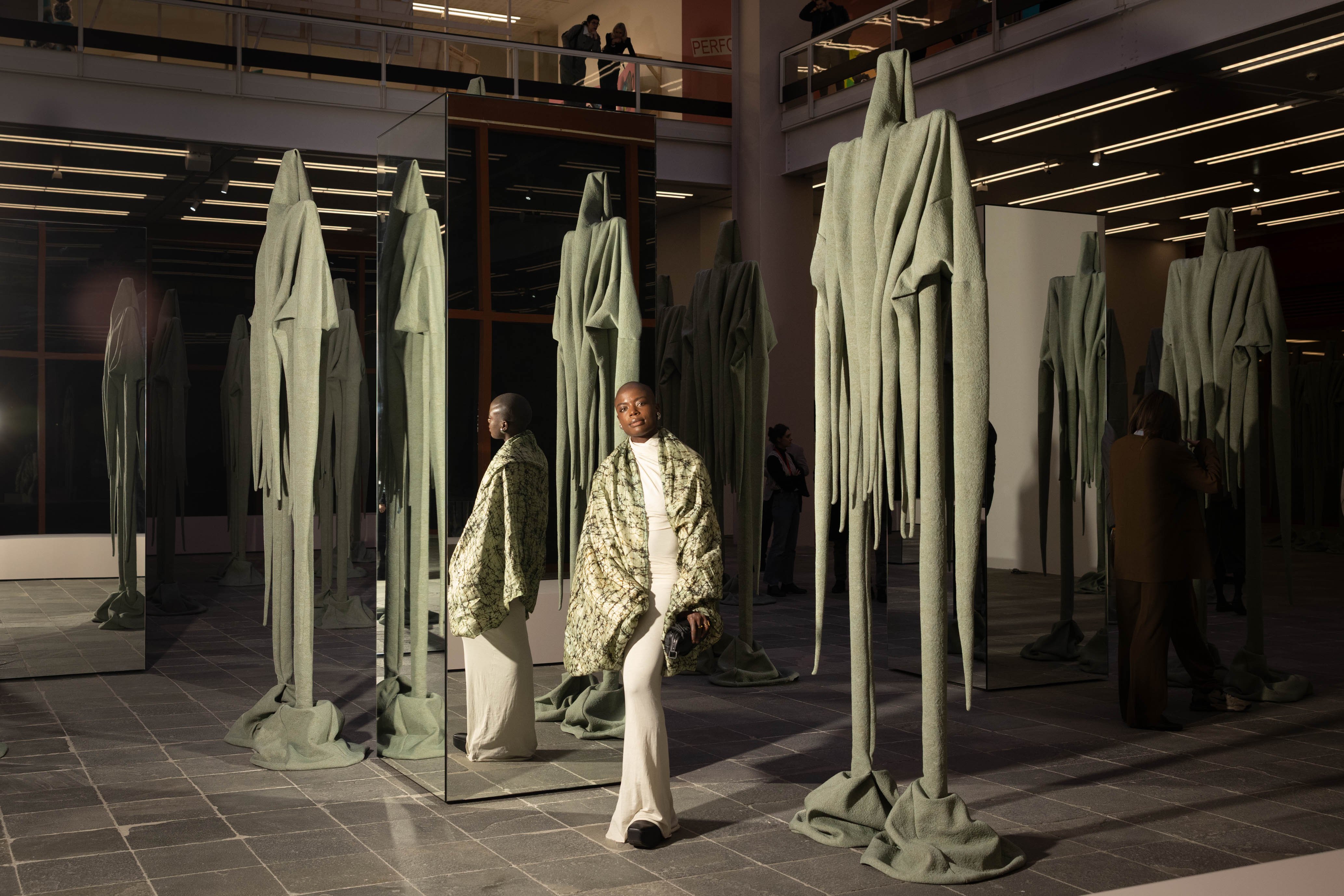
Anyone entering the exhibition space at Belvedere 21 suddenly finds themselves face to face with them: 55 larger-than-life figures bathed in subdued light. Draped in heavy gray-green fabrics, they appear like figures from another time. They are elusive and could come from either the past or the future.
Lisa Ebner-Kollmann
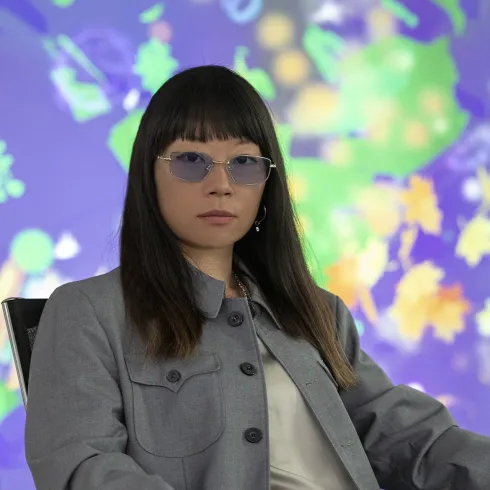
Portrait: Chai Saeidi
Ausstellungsansicht: eSeL.at - Lorenz Seidler
Video: Kunst-Dokumentation.com, Manuel Carreon Lopez / Belvedere, Wien
Some visitors find this situation surprisingly calm. They feel almost at ease. Others experience it as eerie or even threatening. Between these two extremes, an atmosphere unfolds that defies clear definition.
Sandra Mujinga is a contemporary artist, DJ, and musician who works precisely with such moments. She was born in 1989 in Goma (Democratic Republic of the Congo); she lives and works in Oslo. She has gained international recognition primarily for her installations in which sculptures occupy a space.
Her works here revolve around the question of how Black bodies become visible – and who decides this. A significant part of Mujinga’s installations often consists of larger-than-life, hybrid figures. They are faceless and evoke both human and animal bodies, yet elude clear classification. Skin, or rather the surface of the materials used, plays a central role here: it protects, conceals, and simultaneously tells a (life) story. Time and again, the focus is on the tension between visibility and withdrawal – on being present, yet also being able to step back.
In doing so, her works also address issues that play a role in artistic approaches such as Afrofuturism – for instance, in dealing with visions of the future, identity, and the observation of Black bodies in society.
At Belvedere 21, this approach can be experienced firsthand. The exhibition Skin to Skin, created in collaboration with the Stedelijk Museum Amsterdam and first shown there, brings together a large group of identical figures that fill the space. Accompanied by a specially composed electronic soundscape and a total of seven mirrored objects, visitors move right through this constellation and become part of the situation themselves.
The sound is more than just background noise: it is composed of various audio tracks that come together within the space, possesses its own dramatic structure, and changes depending on the visitors’ positions. This creates a shared experience that, at the same time, can never be fully grasped – one that, much like the figures themselves, oscillates between closeness and distance, between community and isolation.
Mujinga’s works touch on questions that extend far beyond the exhibition space. Who is seen in our society – and how? What images of bodies shape our perception? And what possibilities exist for consciously evading these attributions? Her art offers no simple answers, but rather makes these questions physically tangible within the space.