

Looking in the Mirror – The Four Temperaments
A Room of Gold: The Gold Cabinet in the Lower Belvedere
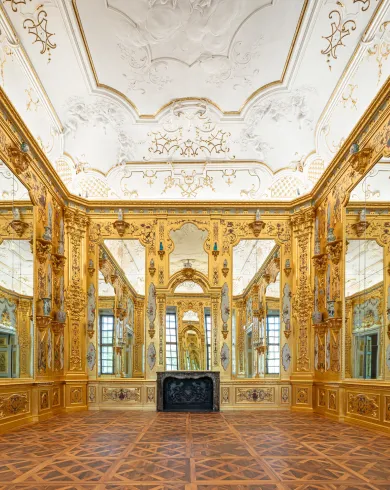
Although our series A Room of Gold focuses primarily on the painted and gilded wooden panels, this time we begin by looking at something else: the mirrors. They occupy almost as much wall space in the Gold Cabinet as the panels themselves. Although the mirrors are no longer the Baroque originals, they still serve a characteristic purpose of the period: creating the illusion of a larger space and making small rooms seem almost endless.
The series “A Room of Gold” is dedicated to the allegorical sets of four in the Gold Cabinet at the Lower Belvedere – the seasons, elements, temperaments, continents, hours of the day, and senses.
Philipp-Reichel-Neuwirth
Johannes Stoll / Belvedere, Wien
Staatliche Kunsthalle Karlsruhe, CC0 / Public Domain
Let’s look in the mirror and ask ourselves: How am I feeling today? Cheerful and talkative? Calm and easygoing? Irritable or even angry? Thoughtful, melancholy, or full of energy?
For centuries, people in Europe believed that everyone was shaped by one of four temperaments: cheerful, lively people were considered sanguine; calm and sluggish individuals, phlegmatic; irritable and hot-headed personalities, choleric; and particularly thoughtful or gloomy types, melancholic. Today, these classifications may seem little more than personality stereotypes. Yet until the Enlightenment of the eighteenth century brought more rigorous empirical standards to scientific inquiry, the theory of the four temperaments played a significant role in European medicine, philosophy, and art.
The Four Temperaments in the Gold Cabinet
In the visual arts, a distinct figure type emerged for each temperament. However, as we have already seen with the other groups of four, these depictions did not follow strict rules and allowed for considerable artistic freedom.
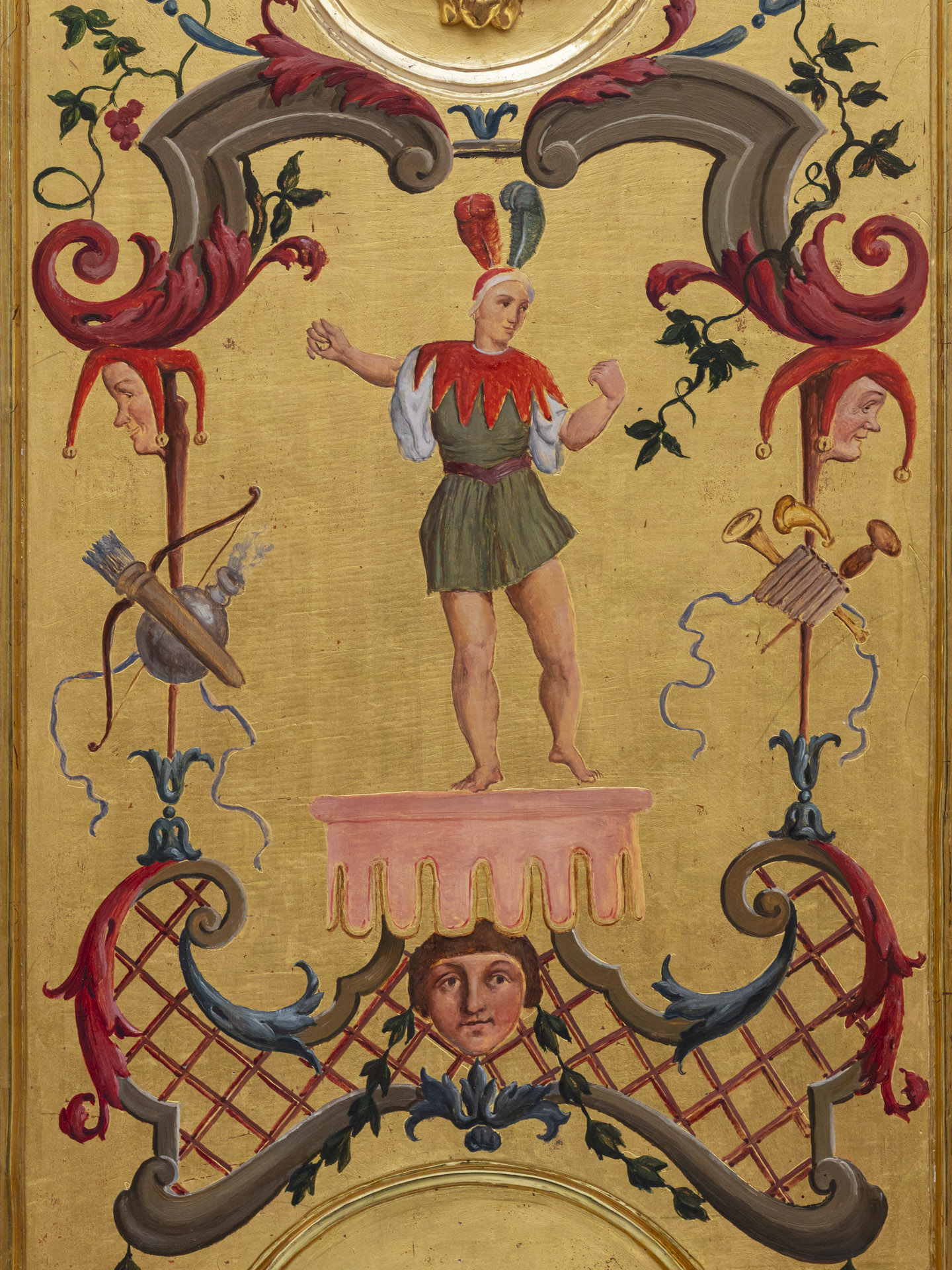
The sanguine figure in the Gold Cabinet wears feathers on his head and a colorful, flowing robe. He appears to be dancing. Heads wearing jester’s caps and musical instruments emphasize the cheerfulness – or rather, the exuberance- associated with this temperament.
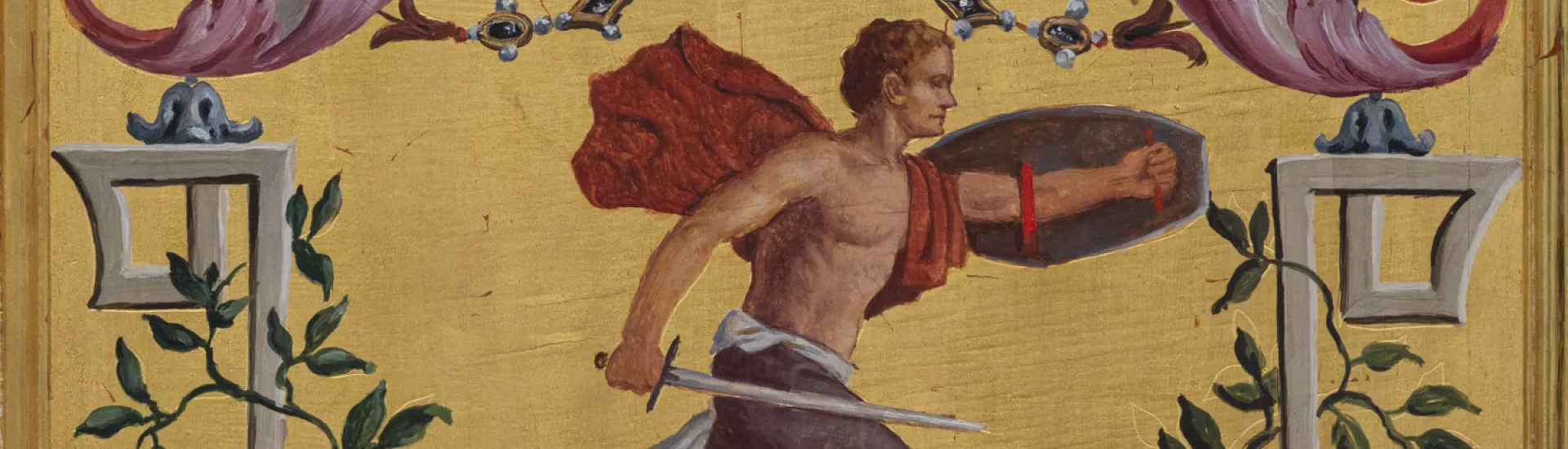
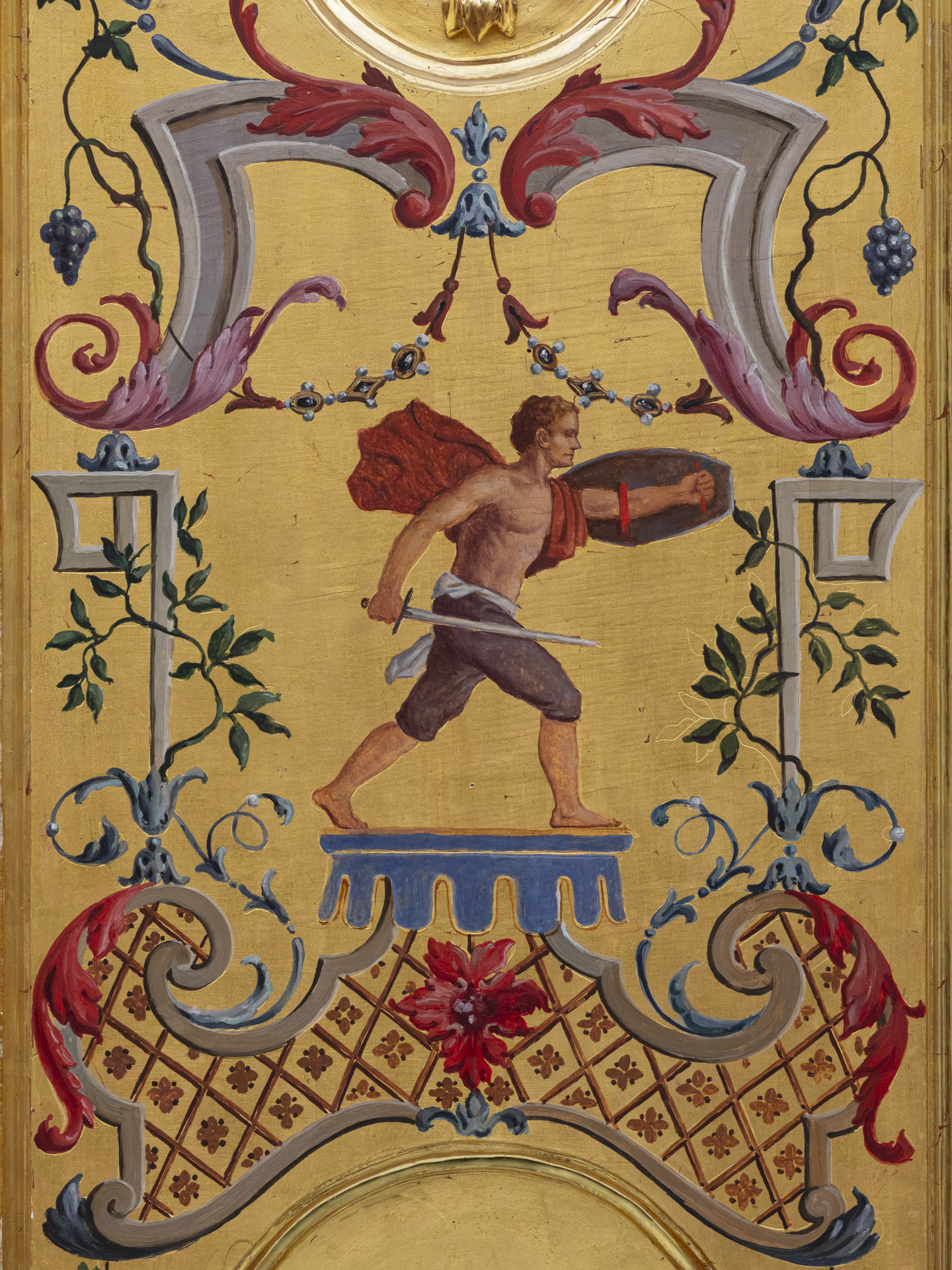
To the right of the mirror, on the same side of the room, we see the choleric figure. Rather than lashing out uncontrollably, he acts with determination and purpose. As he prepares to attack with his sword, a shield on his other arm protects him.
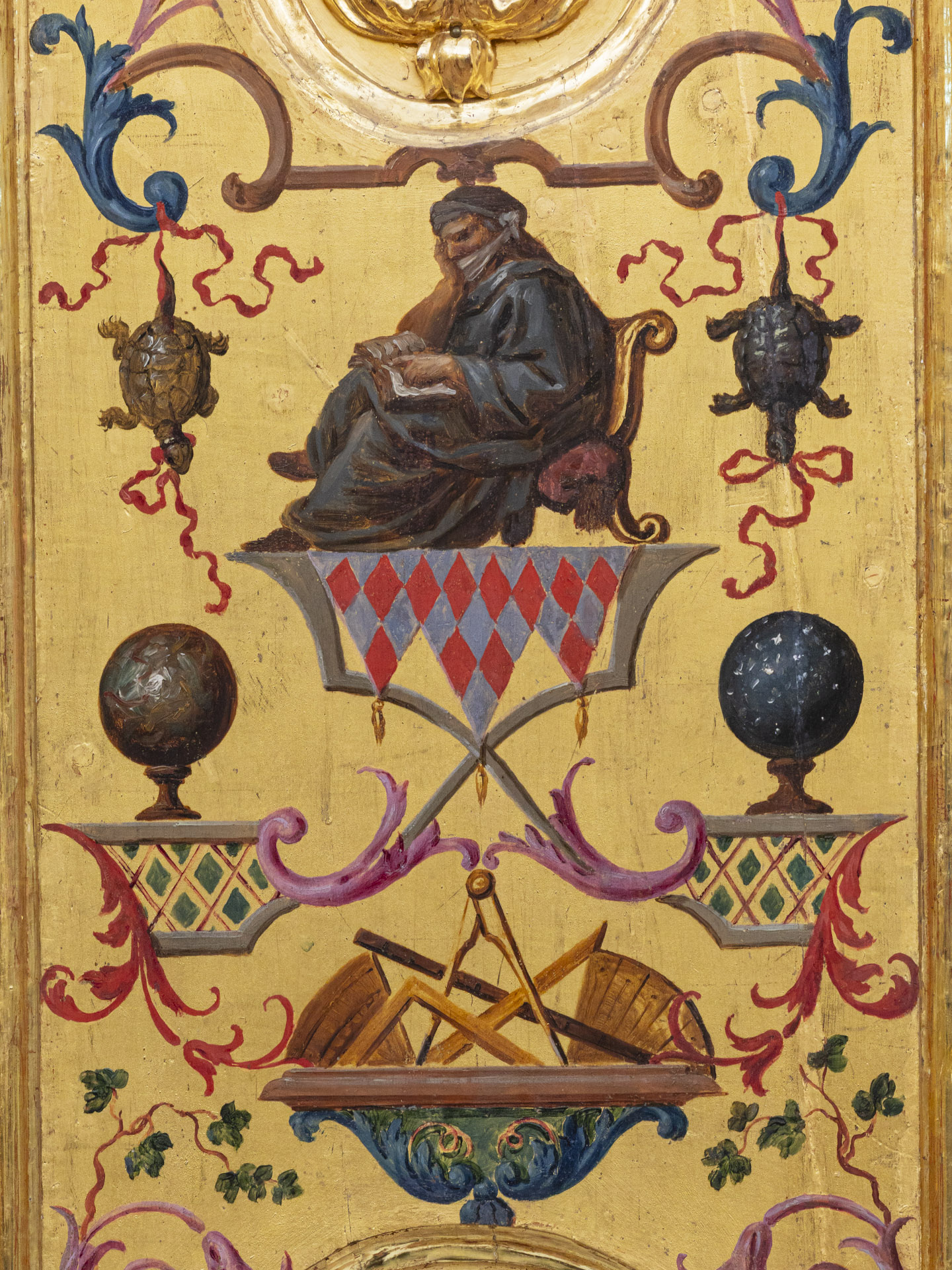
On the opposite side of the Gold Cabinet, the melancholic figure is deep in thought over a book, wrapped tightly in his robe. Below him are geometric instruments such as a set square and a compass. These are common attributes of melancholy, famously featured in Albrecht Dürer’s engraving Melencolia I (1514). Among the four temperaments, melancholy occupies a special place: the melancholic is often portrayed as a thoughtful, educated, or even brilliant figure. Artists, philosophers, and poets readily identified with this type.
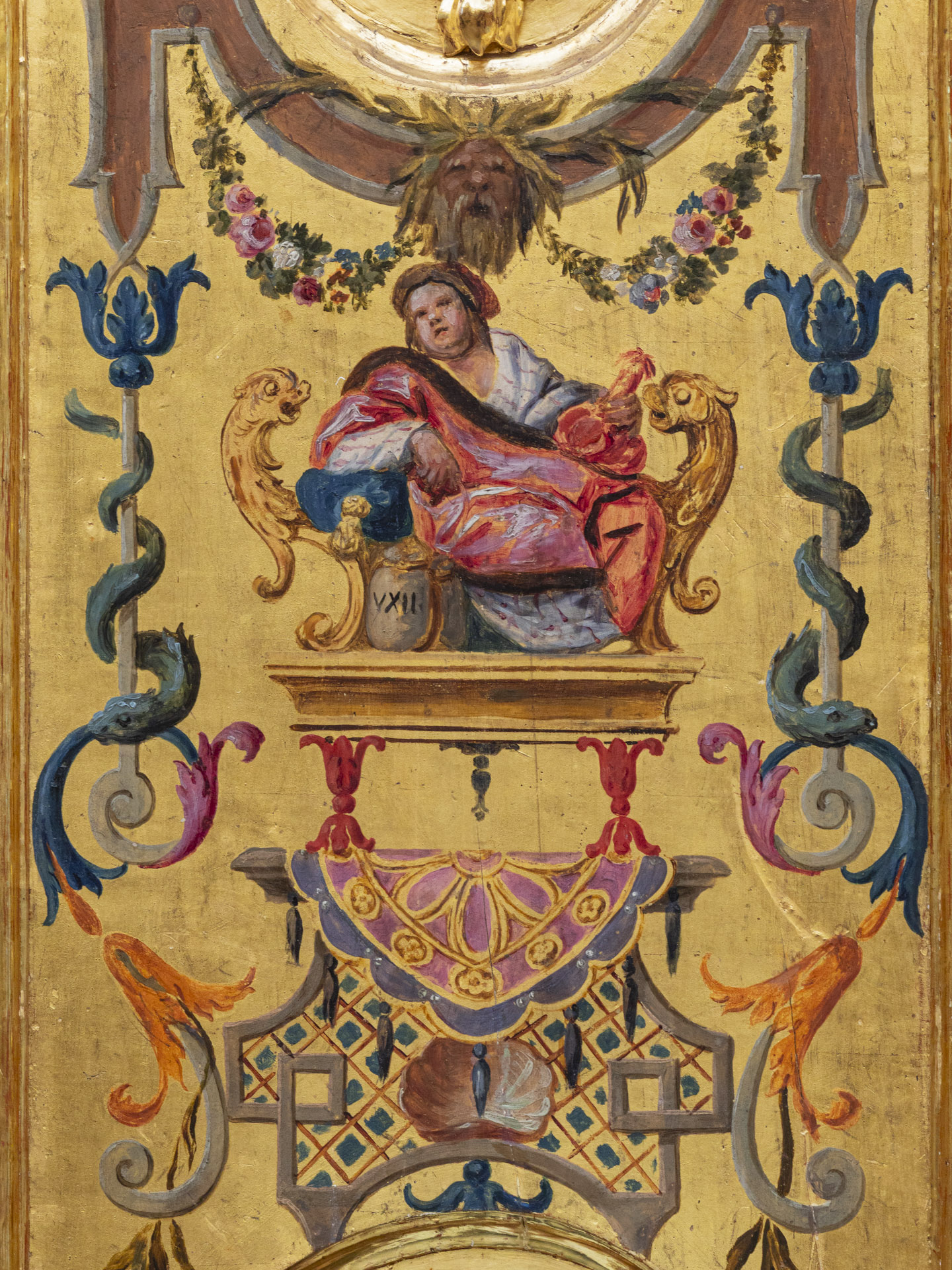
On either side of the melancholic figure are turtles, traditionally associated with the fourth temperament, the phlegmatic. True to his nature, the phlegmatic figure sits languidly in an ornate chair, resting against a blue velvet armrest. In his hand, he holds an object that is difficult to identify: it could be a vegetable (perhaps a potato), but its shape also suggests something phallic.
The Theory of the Four Humors
This classification of people into four temperaments has its roots in the ancient theory of the four humors. Around 400 BCE, the Greek physician Hippocrates established the idea that the human body was governed by four bodily fluids, or humors. The names of the four temperaments were later derived from these fluids: from the Latin sanguis for blood and the Greek terms phlegma for phlegm, cholé for yellow bile, and melaina cholé for black bile.
Several centuries later, the Greco-Roman physician Galen linked the humors to the temperaments, making the theory a central part of European medicine. According to this system, known as humoral pathology, a balance of the four bodily humors was considered essential for good health. An excess of any one humor, however, could adversely affect both body and mind.
Not all humors were regarded as equally problematic. While phlegm, yellow bile, and black bile were associated with illness, blood occupied a special position: an abundance of blood was associated more with vitality and health than with disease. This explains why the sanguine figure is portrayed as cheerful and full of life.
In Good Humors
The theory of the four humors also encompasses the four elements, the four seasons, and the stages of life. According to this system, blood, associated with the sanguine temperament, corresponds to air, spring, and childhood. Yellow bile, associated with the choleric temperament, corresponds to fire, summer, and youth. Black bile, linked to the melancholic temperament, represents earth, autumn, and adulthood. Finally, phlegm, associated with the phlegmatic temperament, corresponds to water, winter, and old age.
Hippocrates, for example, believed that a particularly dry summer could be harmful to people with a choleric disposition, while those with a phlegmatic disposition might benefit from it: the hot, dry weather would balance their cold, moist constitution. His observations, however, referred to the bodily humors rather than the temperament types developed later.
A closer look at the Gold Cabinet suggests that the seasons, elements, and temperaments may also be connected here. Yet only one pairing corresponds to the traditional system: the sanguine figure is positioned near the allegory of air. Artistic freedom – or perhaps a lack of knowledge during later restorations – may explain why the other figures do not follow the traditional arrangement. In short, perhaps the rules weren't taken quite so seriously after all.
Similar ideas about the interplay of fundamental energies and qualities, and their influence on body and mind, can be found in other medical traditions, including Ayurveda and Traditional Chinese Medicine. Despite their different foundations, these systems share the belief that maintaining a balance between certain forces is essential to health.
Modern evidence-based medicine takes a critical view of such simplistic classifications. Yet even today, we encounter ideas that assign people to certain types based on just a few characteristics, promising simple answers to complex questions.
Let’s take one last look in the mirror of the Gold Cabinet.
What do we really see? A wonderful human being with many facets – not just a single category.
Gallery