

The Five Senses
A Room of Gold: The Gold Cabinet in the Lower Belvedere
In the Gold Cabinet of the Lower Belvedere, the senses are depicted in human form, alongside allegorical groups representing the four elements, the four seasons, and other natural phenomena. Yet they stand somewhat apart from these groups: we usually speak not of four, but of five senses.
The series “A Room of Gold” is dedicated to the allegorical sets of four in the Gold Cabinet at the Lower Belvedere – the seasons, elements, temperaments, continents, hours of the day, and senses.
Philipp-Reichel-Neuwirth
Johannes Stoll / Belvedere, Wien
What do you smell? Can you feel the weight of the tablet or smartphone in your hand? How does the surface you’re sitting on feel? What sounds do you hear? Can you still taste something on your tongue? How do you perceive the light?
The Five Senses in the Gold Cabinet
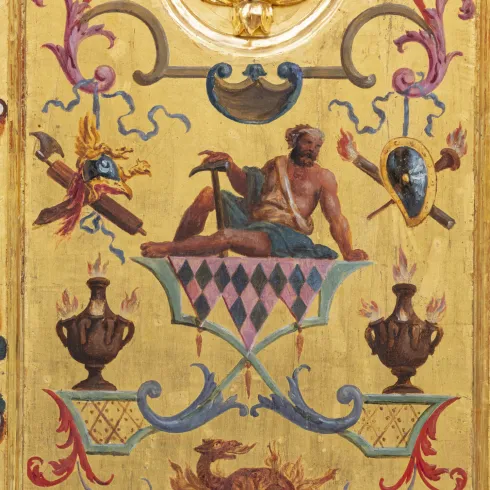
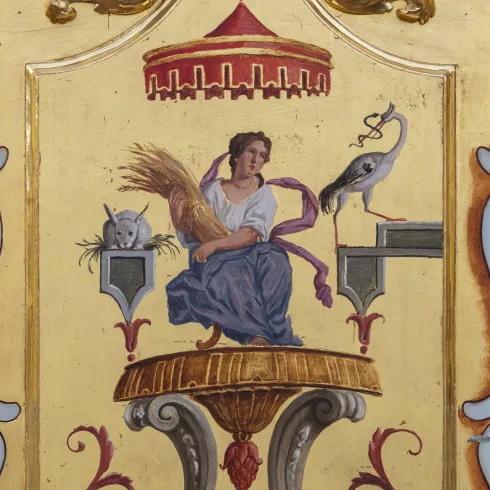
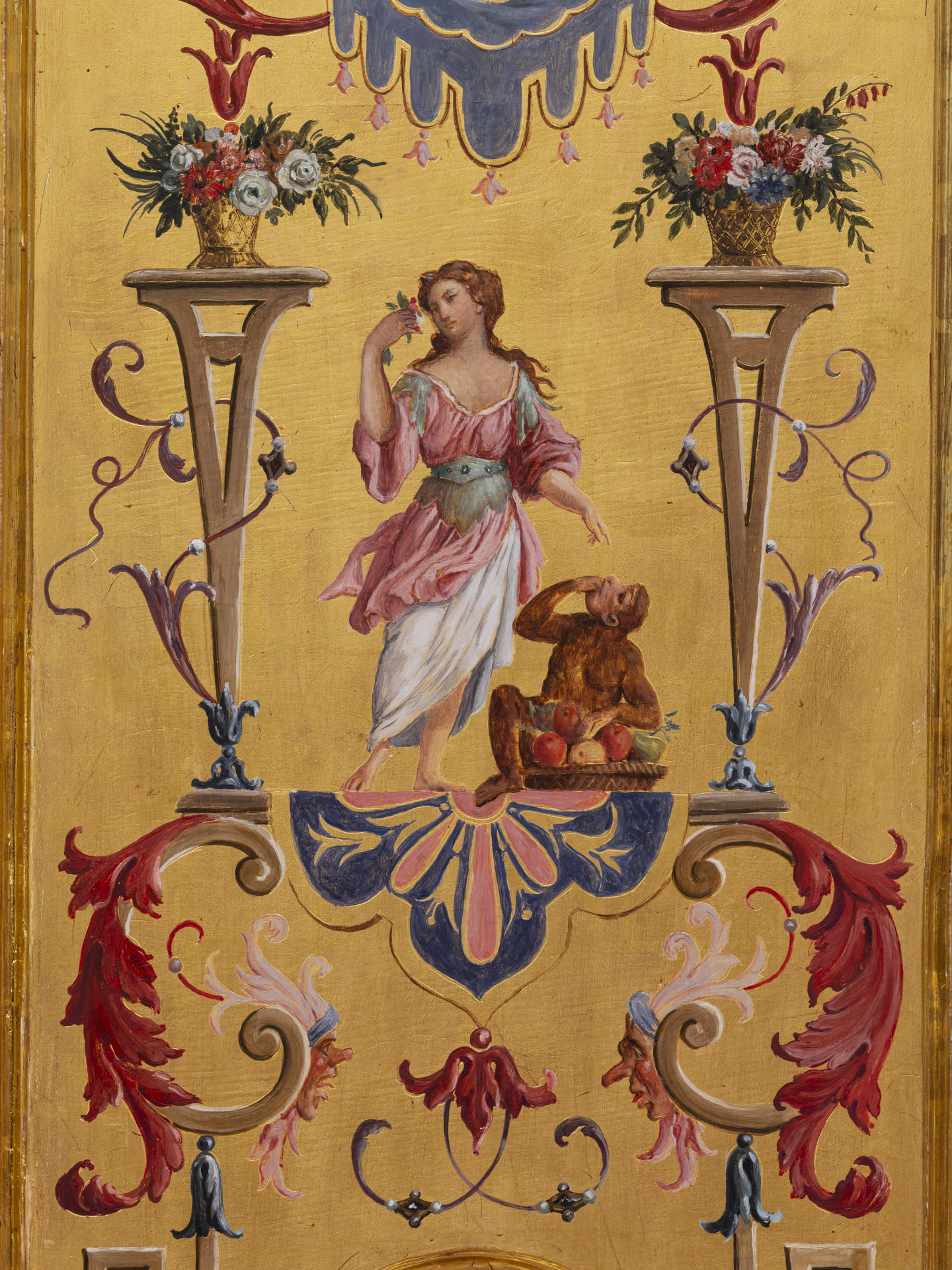
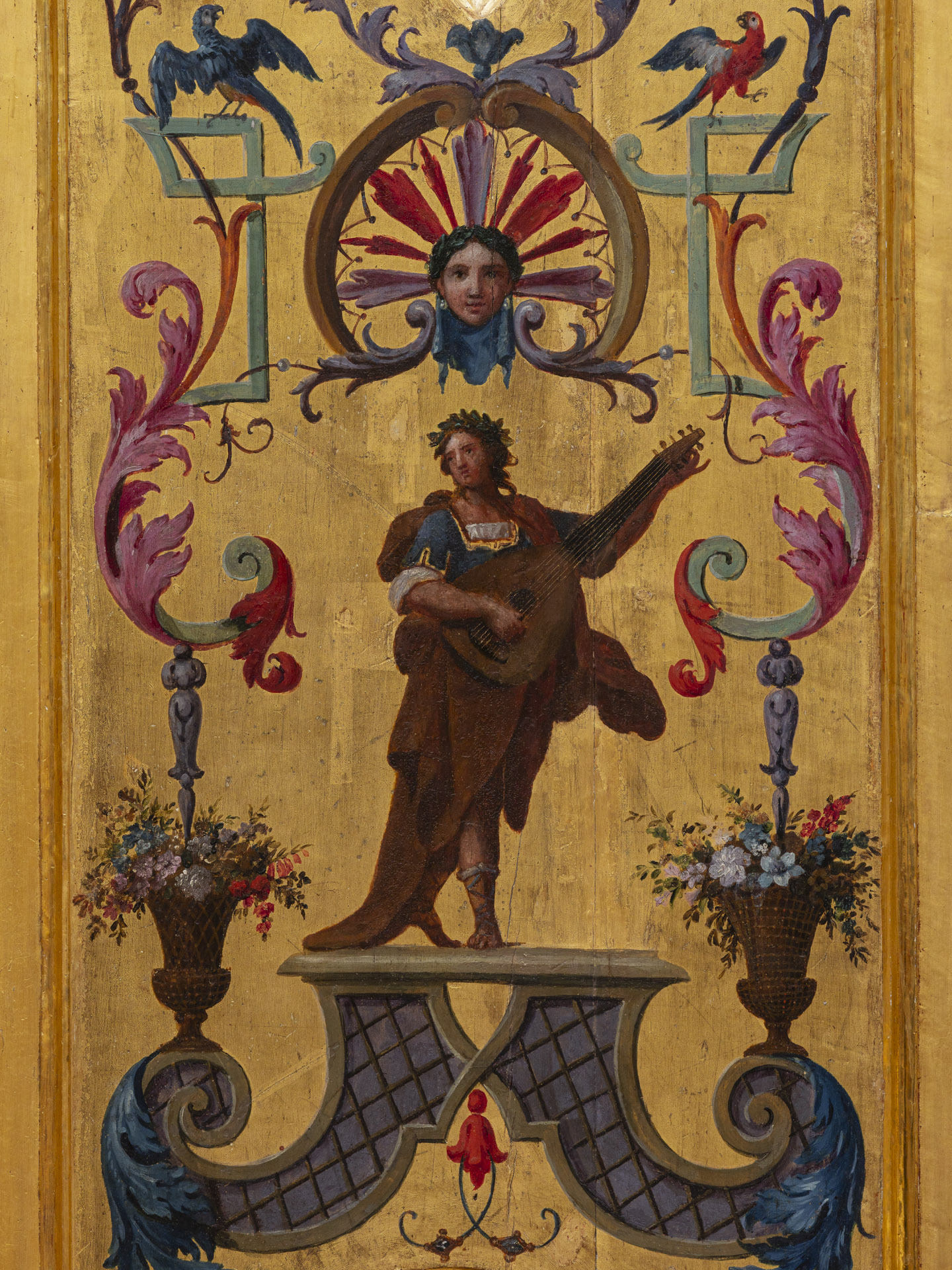
Sight, hearing, touch, smell, and taste are depicted together in four paintings in the Gold Cabinet of the Lower Belvedere. Taste and smell appear as a pair.
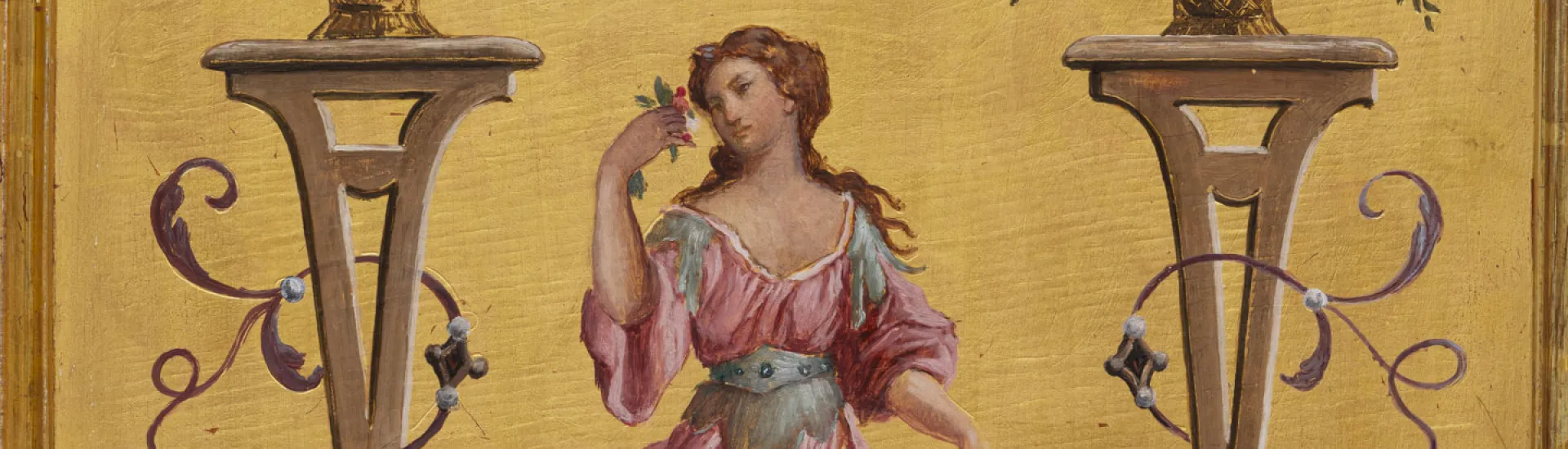
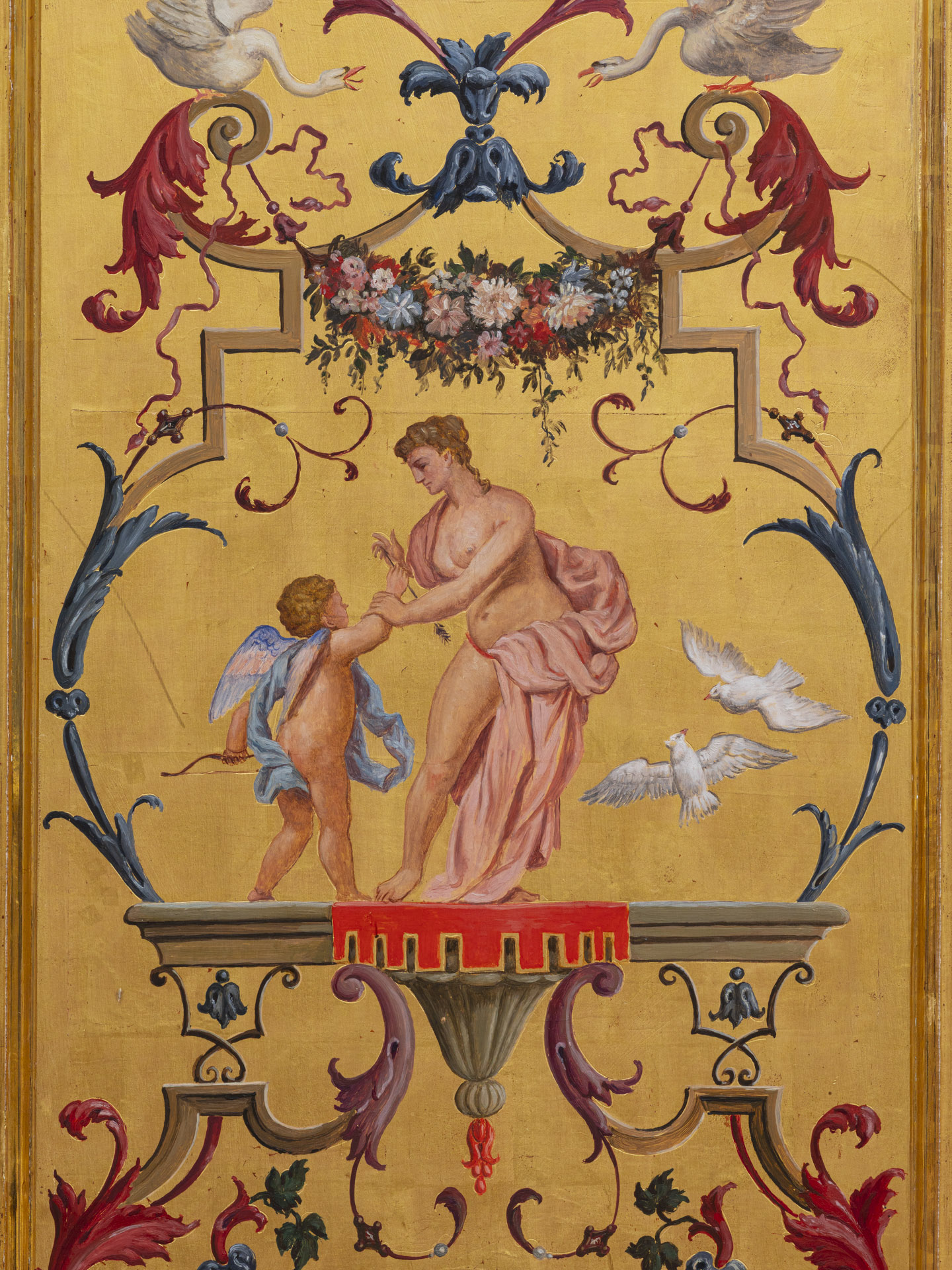
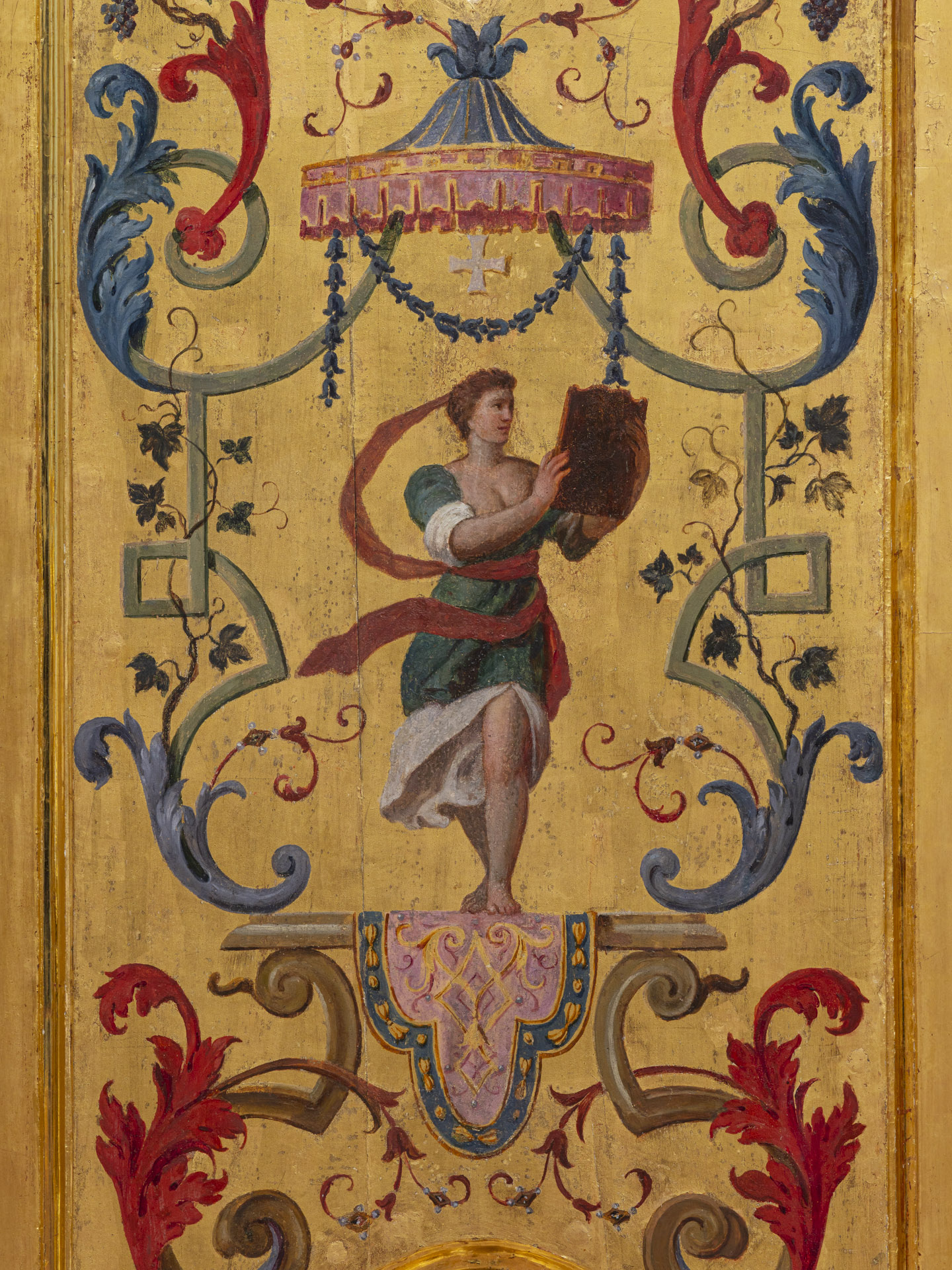
In the entire group, only one ancient deity is recognizable this time: Venus, the goddess of love, who is reprimanding her son Cupid by grabbing him by the arm, represents the sense of touch. The sense of sight, in the form of a woman, is presumably looking at herself in a mirror she holds in her hands. She resembles the personification of the sense of smell, who holds flowers to her nose and points with one hand at a monkey crouching beside her. The animal is eating fruit, thus symbolizing the sense of taste. Hearing is the only sense represented through the source of the sensory stimulus rather than the act of perception itself: a figure with a kithara symbolizes music.
The Five Senses – A Competition
When the ancient Greek philosopher Aristotle discussed the five senses in his treatise On the Soul (Greek: Peri psychēs), he arranged them hierarchically:
- Sight
- Hearing
- Smell
- Taste
- Touch
This reflects a long-standing philosophical and religious tendency to regard the physical as inferior. Taste and touch require direct contact between the skin and the material world, whereas the other senses receive their stimuli from what was considered a nobler distance from the material world. This goes hand in hand with a tendency in culture and religion to attribute greater value to the spiritual. Hearing, seeing, and smelling seem closer to the metaphysical than to the physical.
In the Judeo-Christian tradition, the sense of hearing has repeatedly been given top priority. Revelations and divine messages were often perceived as voices. The Jewish profession of faith begins with the words „Sch'ma Jisra'el“ – “Hear, O Israel.” (Deuteronomy 6:4). Martin Luther, too, emphasized the importance of hearing, linking faith to hearing the Word of God.
The sense of touch is associated with eroticism and, in accordance with religiously influenced notions of virtue, ranks last. In the Gold Cabinet of the Lower Belvedere, by contrast, touch takes the form of a disciplinary gesture: a stern mother grips her child by the arm.
The Gold Cabinet itself was made for the eye – and Baroque palaces, as well as museums in general, have traditionally privileged seeing over hearing. The reverberation in a Baroque marble hall can make it difficult to understand spoken words. Sounds and audio tracks are not easy to manage in a museum setting. Sound installations often pose challenges for both the curatorial concept and the technical implementation of an exhibition. Sounds are often regarded as a source of distraction. Yet in an atmosphere of overly reverent silence, they can also be sorely missed – particularly by visually impaired and blind visitors when information is provided only in written form. Audio descriptions can fill this silence.
Prince Eugene, who commissioned the construction of the Belvedere, was not considered a particularly great lover of music or the performing arts. Nevertheless, stories about the prince mention a musician who is believed to have been in his service: Jacques de Saint-Luc, a prominent lutenist. His compositions have survived to this day. Even though there is no evidence that the depictions of the senses were affixed to the gold panels during the prince’s lifetime, the figure representing the sense of hearing – depicted as a kithara or lute player – has a fitting biographical connection to Eugene of Savoy, in whose chambers the delicate sound of plucked strings may indeed once have been heard.
At the Lower Belvedere, however, smell might well have been the secret favorite among the five senses. Before the so-called Pomeranzenhaus – the exhibition space now known as the “Orangery” – was built, large rooms in both wings of the Lower Belvedere were indeed used to house orange trees, which would likely have filled the rooms with their intense fragrance. Let us now imagine the prince taking an afternoon nap right here, in the very spot where the Gold Cabinet stands today: the palace doors stood open, and the fresh scent of oranges wafted through the Grotesque Hall and the Marble Gallery to Eugene’s nose. In the early modern period, colonial imports brought previously unknown plants, and with them new scents and flavors, to the gardens and palaces of Europe. The sensual abundance celebrated here was thus also, in part, made possible by the exploitation of natural resources on other continents.
Next to the allegory of the sense of smell, a monkey sits in front of a fruit bowl and appears to be licking its fingers, perhaps still savoring the taste of oranges or other citrus fruits. The animal symbolizes the sense of taste. This sense – though presumably relegated to the lowest rank in the hierarchy due to its depiction as a monkey as well as its positioning – has an advantage over the other senses. It contains yet another four-part classification shaped by European tradition: the four tastes – sweet, sour, bitter, and salty.
The Five Senses byHans Makart
On the subject of sweetness: the opulent Baroque style of the seventeenth and eighteenth centuries was deliberately revived in the second half of the nineteenth century, following the more restrained aesthetics of Classicism and Biedermeier. Its richness of form and color was heightened to the point of almost ironic sweetness. One artist in particular came to embody this tendency: Hans Makart.
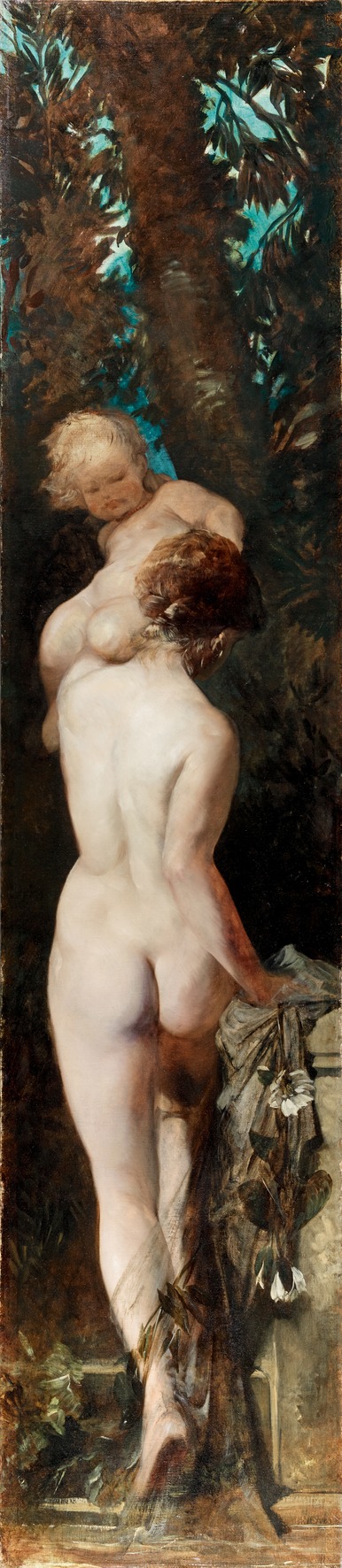
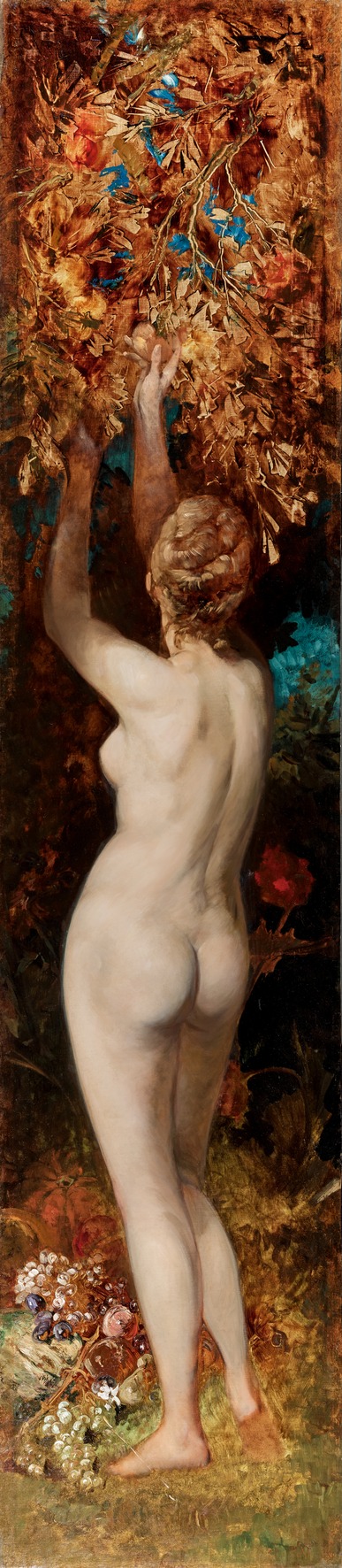
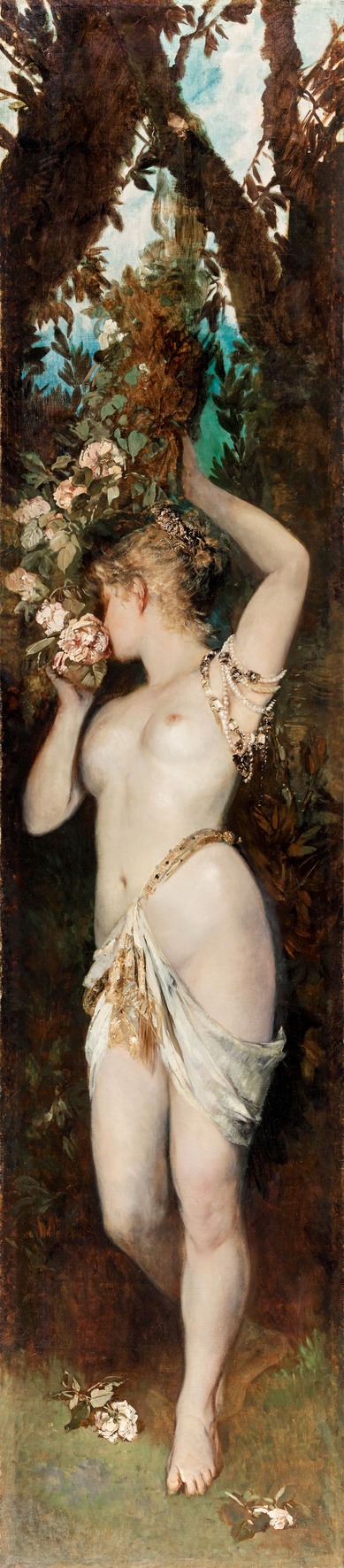
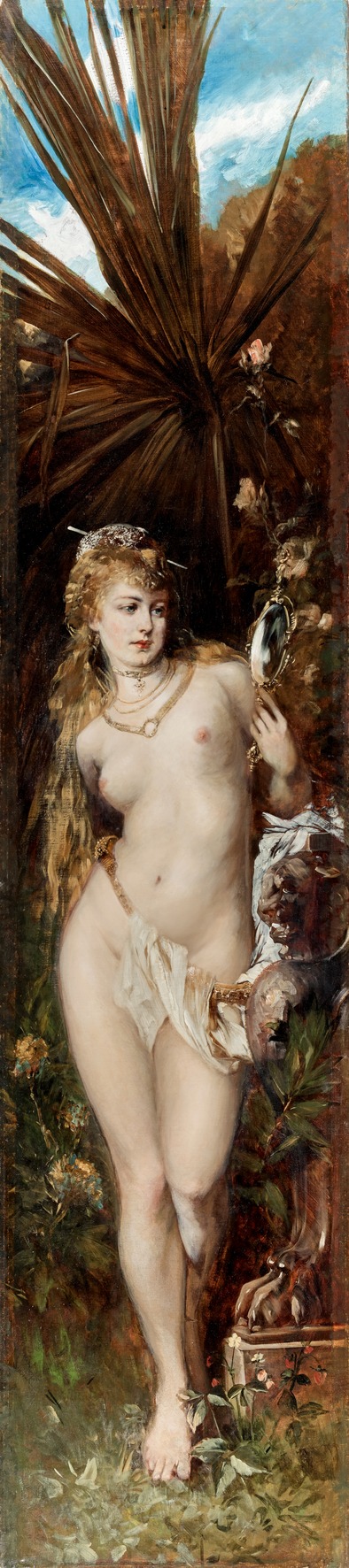
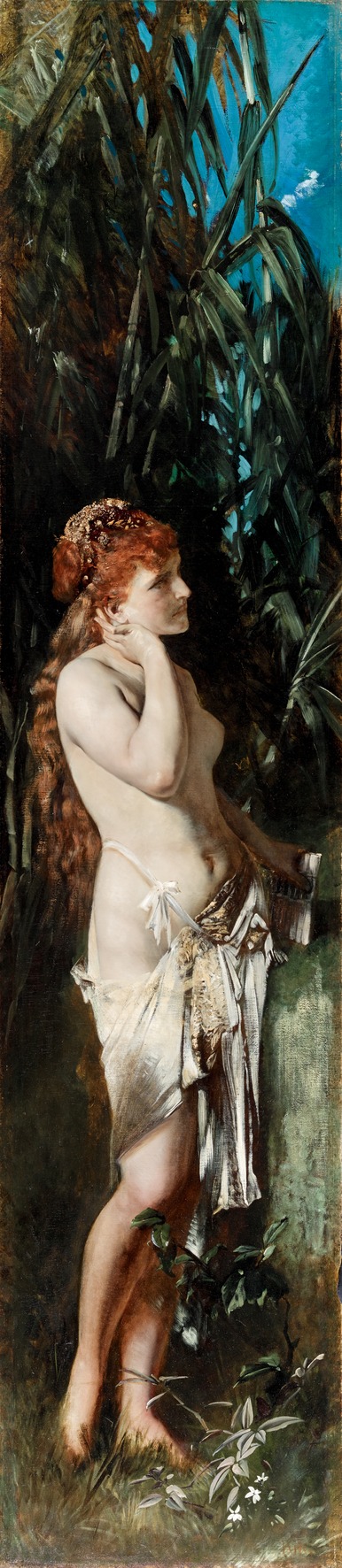
The Belvedere collection includes five vertical-format paintings depicting the five senses, which Makart – in his typical style – portrayed as nude female figures. Set against a backdrop of lush trees and plants, each painting shows a different side of the body, so that they appear to turn as they progress from one painting to the next.
Moving between the erotic nude and ostensibly serious allegory, Makart repeatedly staged the female body in his work, although in this series of the Five Senses he remained relatively restrained in his treatment of physicality. After all, it was still the nineteenth century, an era of heightened sexual restraint. Hearing poses with one hand to her ear rather than appearing to actually listen. Touch is depicted – much like in the Gold Cabinet – as a sort of mother-child pairing, though here in a moment of somewhat awkward acrobatics. Makart’s depiction of Taste is significantly more restrained than the monkey in the Gold Cabinet: a female figure seems less intent on eating fruit – let alone actually picking it – than on presenting an elegant view from behind. Only Smell presses her nose sensuously into a blossom, holding the entire branch as if in reverence for its pleasing fragrance.
It stands to reason that Makart, following European tradition, accorded the greatest importance to Sight by presenting the figure frontally. The female figure gazes at herself in the mirror, similar to the allegory in the Gold Cabinet. In doing so, however, Makart exposed this naked female body – even more so than the allegories of the other senses – directly to the viewer’s gaze. More precisely, to the sexualizing gaze commonly referred to as the male gaze, which has shaped not only art but visual culture more broadly.
Our everyday lives are shaped by a multitude of sensory impressions. Sometimes they become too much for us, and sometimes we find ourselves craving a specific taste, smell, or sensation. Perhaps you’re now in the mood for fresh fruit or a special fragrance. Maybe you feel like listening to your favorite music, settling into your favorite spot by the window to enjoy the view, or feeling your most comfortable clothes against your skin. Let yourself be inspired, find a moment of peace, and surrender to your senses.
Gallery