

Hidden in Plain Sight
The New Visitor Center of the Belvedere
The forthcoming Visitor Center at the Upper Belvedere, designed by the Graz-based architectural firm epps, aims to address what the landmarked palace and its visitors have long been missing.
Elemer Ploder
Petra Simon
epps Ploder Simon ZT GmbH
Isabella Marboe
“Come for a Kiss!” The Upper Belvedere is Austria’s most visited art museum. In 2025 over 1.5 million people visited this location alone.* “We are delighted by the ever-growing public interest. However, the Baroque palace was never built for today’s visitor numbers,” explains Managing Director Wolfgang Bergmann, underlining the urgency of the planned Visitor Center. “Only with it can we continue to offer a high-quality visitor experience.” General Director Stella Rollig adds, “Not only should the collection displays, special exhibitions, and educational programs meet the highest standards, but the entire visitor experience has to live up to them as well.”
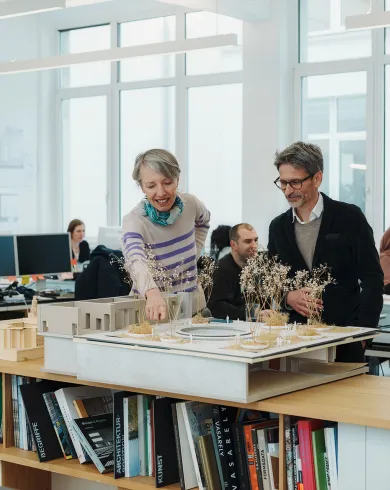
In 2023, an international competition was launched to design the new Visitor Center. Eighty-two architectural teams participated, and after three days of intensive deliberation, the jury selected the Graz-based firm epps architekten – Ploder Simon as the winner.
“An illuminated ceiling will give the impression of having the sky above you.”
Petra Simon
Isabella Marboe
Integrating a large new structure into one of Austra’s most important monuments is an extremely complex task. What drew you to it?
Petra Simon
We’ve spent many, many years working within historic structures. We always begin by asking: What was here? What is here now? And what is needed? What interests us is this continual evolution of historical layers, in which we are all rooted.
Isabella Marboe
The Belvedere is a UNESCO World Heritage Site. What does it mean to approach a historic setting of such exceptional high-quality?
Elemer Ploder
The Belvedere is a cosmos unto itself. The members of the Federal Monuments Authority made it clear that new structures or larger openings in the southern part of the garden are entirely prohibited or limited to an absolute minimum. Nothing may be visible above ground.
Isabella Marboe
How can you intervene in such a closed cosmos without disturbing it?
Petra Simon
In the end, architecture is experienced through perception. We wanted visitors to become part of the Belvedere cosmos. This personal encounter with the building was essential to us.
Isabella Marboe
At the moment, it’s actually quite hard to get your bearings at the entrance. You’re standing in front of the narrow side of one of the palace’s wings rather than its main façade—and, to make matters worse, the Kavalier Wing sits right beside the garden gate.
Petra Simon
Our goal was to spark excitement about visiting the Belvedere. Most people just want to see Klimt’s The Kiss.
Elemer Ploder
And to get a good Instagram photo of it.
Petra Simon
But they don’t actually get to experience the Belvedere itself.
Elemer Ploder
Ideally, they would enter from the Gürtel side, through the Lion Gate to the south. That’s where the Baroque staging of the pond, garden, and palace is at its most impressive.
Isabella Marboe
Ideally, they would enter from the Gürtel side, through the Lion Gate to the south. That’s where the Baroque staging of the pond, garden, and palace is at its most impressive.
Elemer Ploder
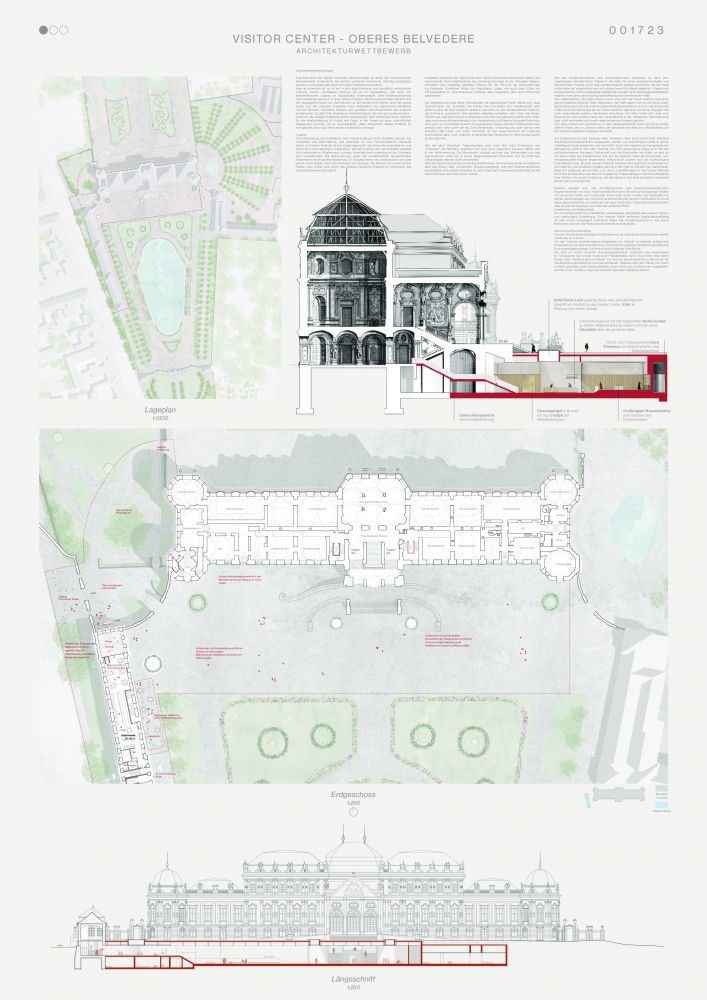
Most tourists arrive via the Prinz-Eugen-Strasse. The competition prompt therefore required that the main entrance be located there. But that would not have generated a true sense of arrival, which is why we decided to position the entry near the Peach Garden on the Prinz-Eugen-Strasse. The Federal Monuments Authority has a historical plan from 1850 showing the site’s earlier state. We aim to restore that condition and have incorporated it into our designs.
Petra Simon
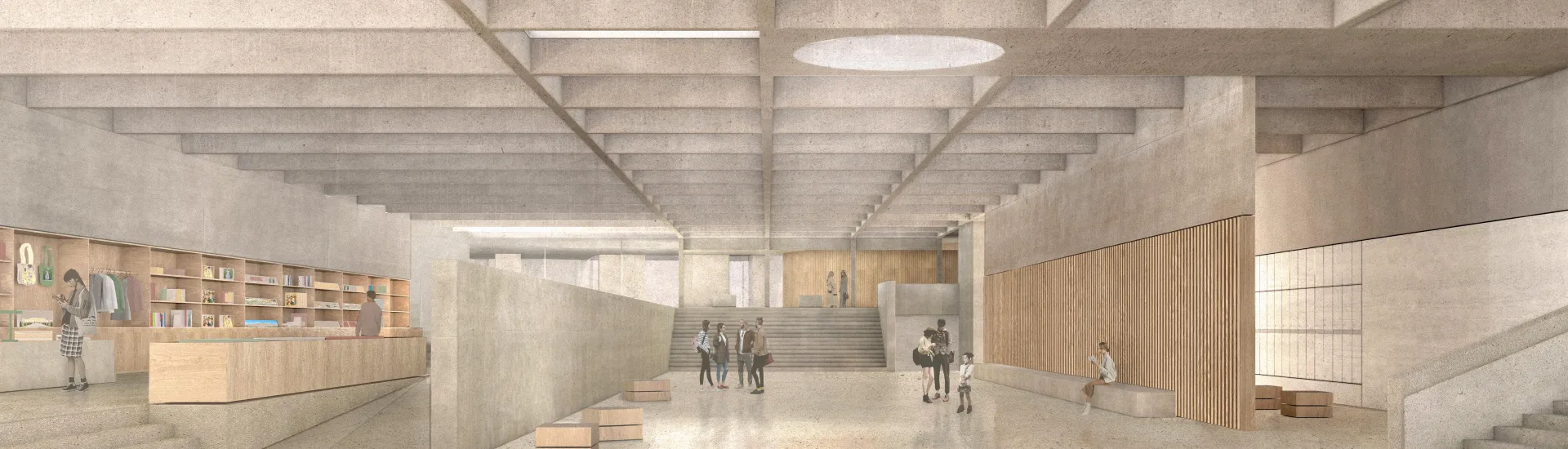
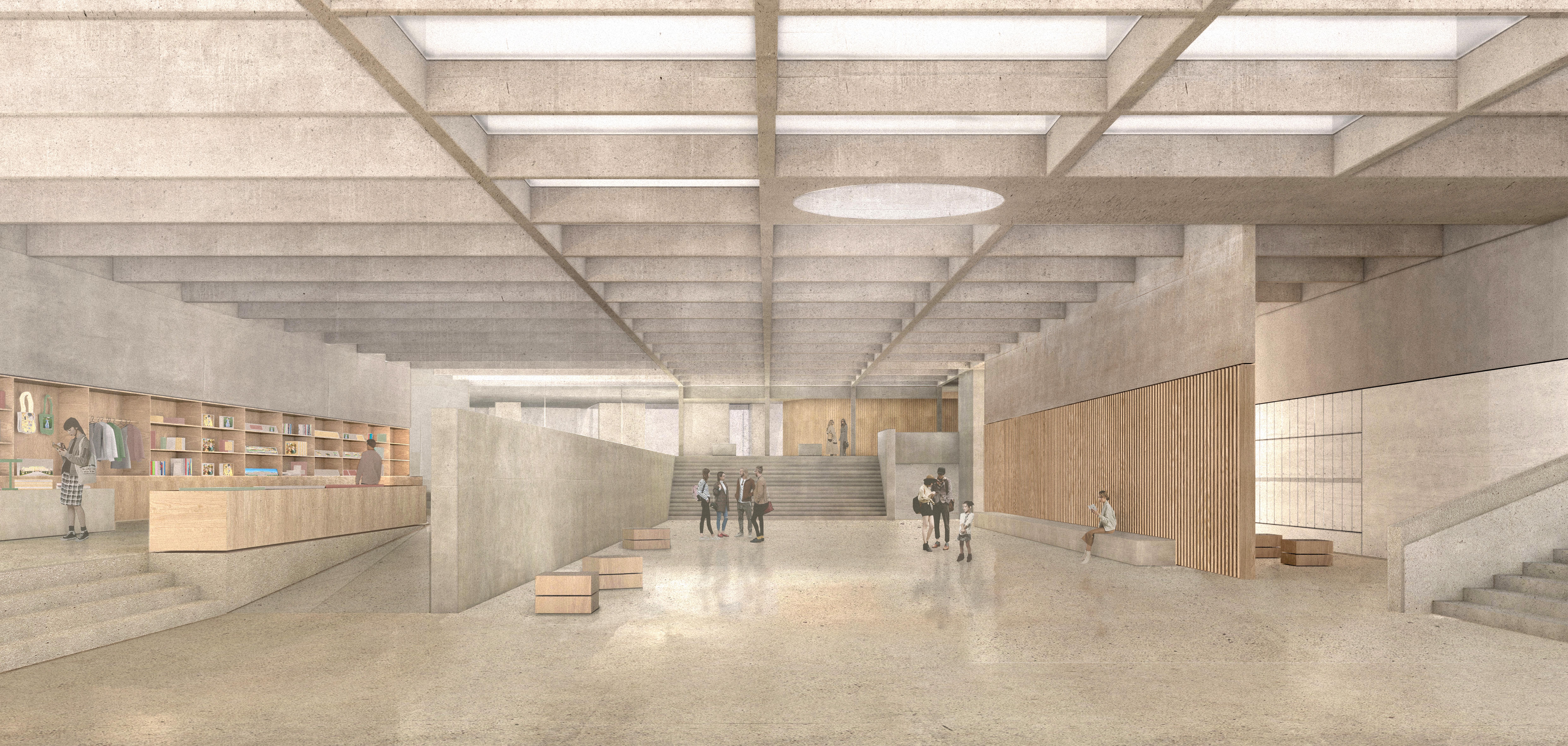
We’re creating a sequence of spatial experiences. Visitors enter the lobby from the lower plinth level at the corner of the Kavalier Wing, descending about a meter into the area beneath today’s ticket office. Removing the ceiling allows the space to open all the way up to the vaulted structure above—a beautiful, lofty entrance hall. A short flight of steps leads down to a landing. From there, you turn 90 degrees and arrive in the foyer with its circular skylight.
Elemer Ploder
That is where visitors get their bearings, see what exhibitions are on, where to buy tickets, and so on. Even the security check can take place there.
Isabella Marboe
The Visitor Center has an enormous capacity while still remaining invisible. What scale are we talking about?
Elemer Ploder
The key figure is the 900 people currently allowed inside the palace per hour. They need spacious cloakrooms and a shop—an elegant solution runs the length of the hall beside a long, gently sloping, ramp-like staircase with several intermediate landings. Then there are technical spaces, storage areas, ancillary rooms, and catering infrastructure—in short, everything the historic palace has been lacking.
Petra Simon
The Visitor Center also serves as a buffer space for visitors waiting for their time slot. The space offers a high level of comfort and invites people to linger. Near the shop, a gently sloping ramp ensures full accessibility—for visitors with disabilities as well as for the many parents with strollers and small children.
Isabella Marboe
The Visitor Center is underground. How do you ensure that it doesn’t feel like a basement?
Petra Simon
An illuminated ceiling will give the impression of having the sky above you.
Elemer Ploder
An illuminated ceiling will give the impression of having the sky above you.
Petra Simon
Orientation is crucial. Through two round skylights beneath the Belvedere’s central avant-corps, visitors can look upward from the hall toward the palace.
Elemer Ploder
These light wells flank a double staircase leading upward, mediating between the public space and the museum proper. With these two staircases, the new structure interlocks with the existing building. As visitors ascend, they glimpse the undersides of the grand staircase and the groin vaults—the transition is seamless.
Petra Simon
The Belvedere itself tells the grand story. The most beautiful result would be if we can manage to turn this space of passage into a place of encounter.
Article first published in "Belvedere Kunstmagazin" no. 2-2024.
*Ed.n.: Referenced numbers have been updated when republished in 2026.