

Voices from the Past
Georg Lechner on Looking Closely at Art and History
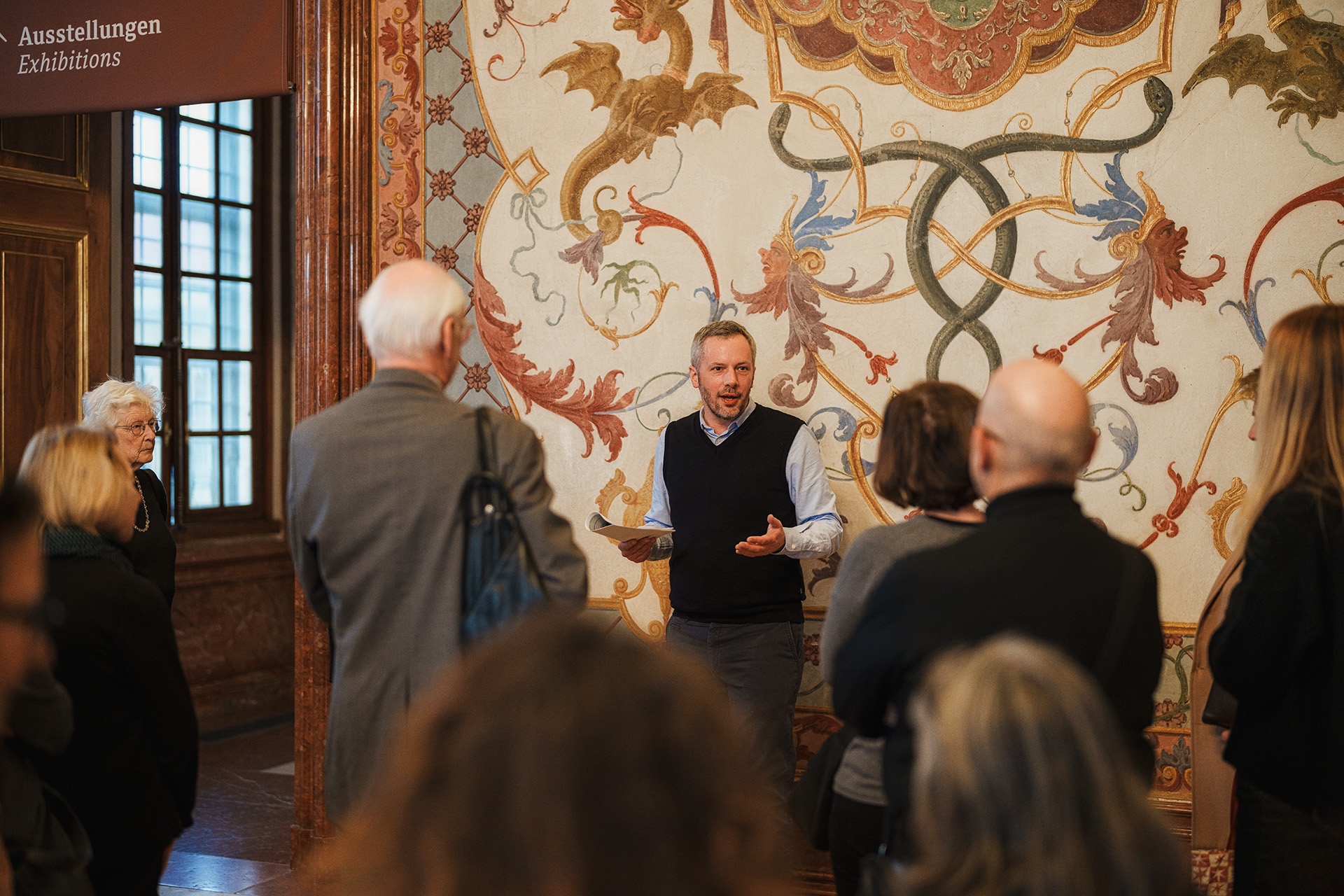
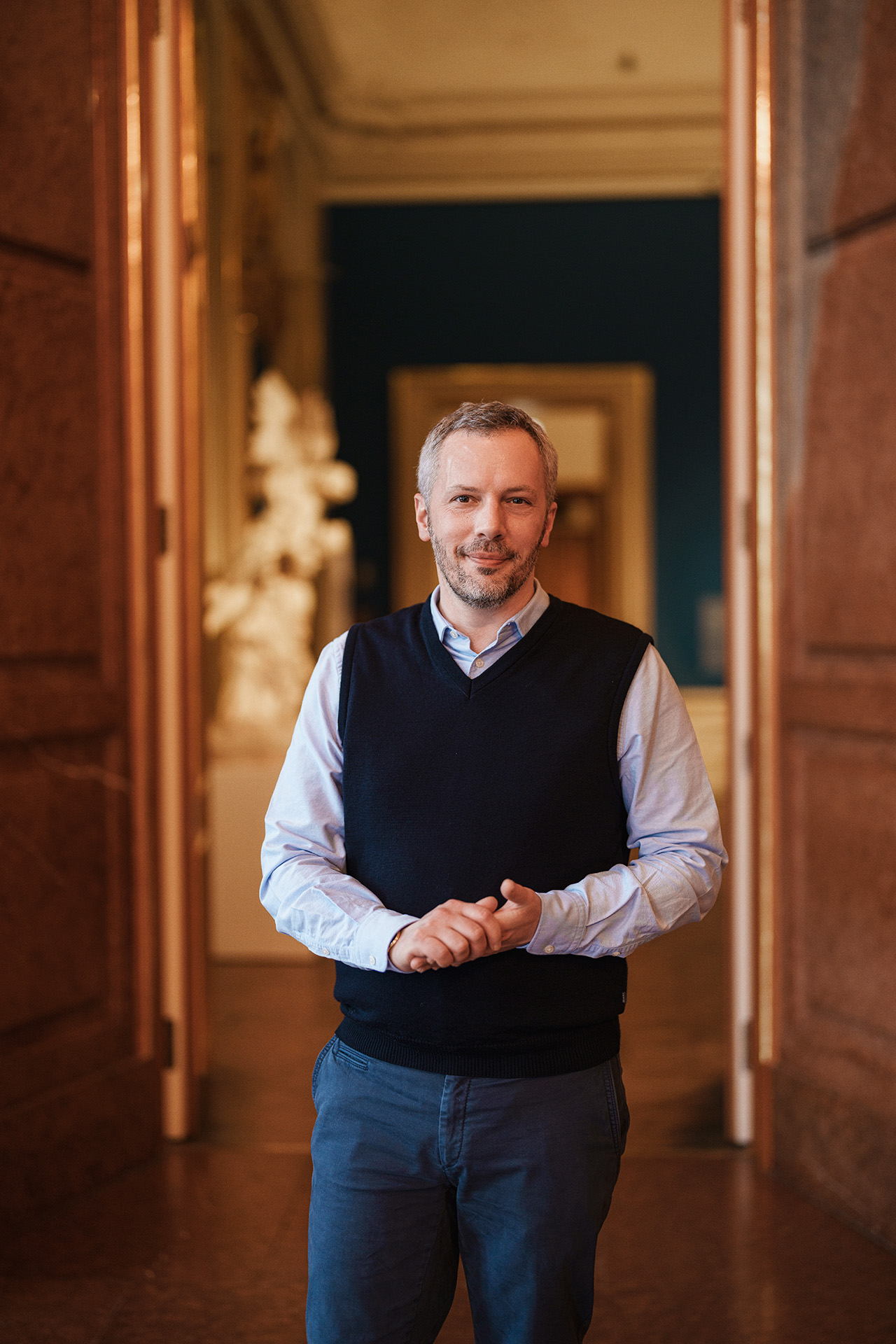
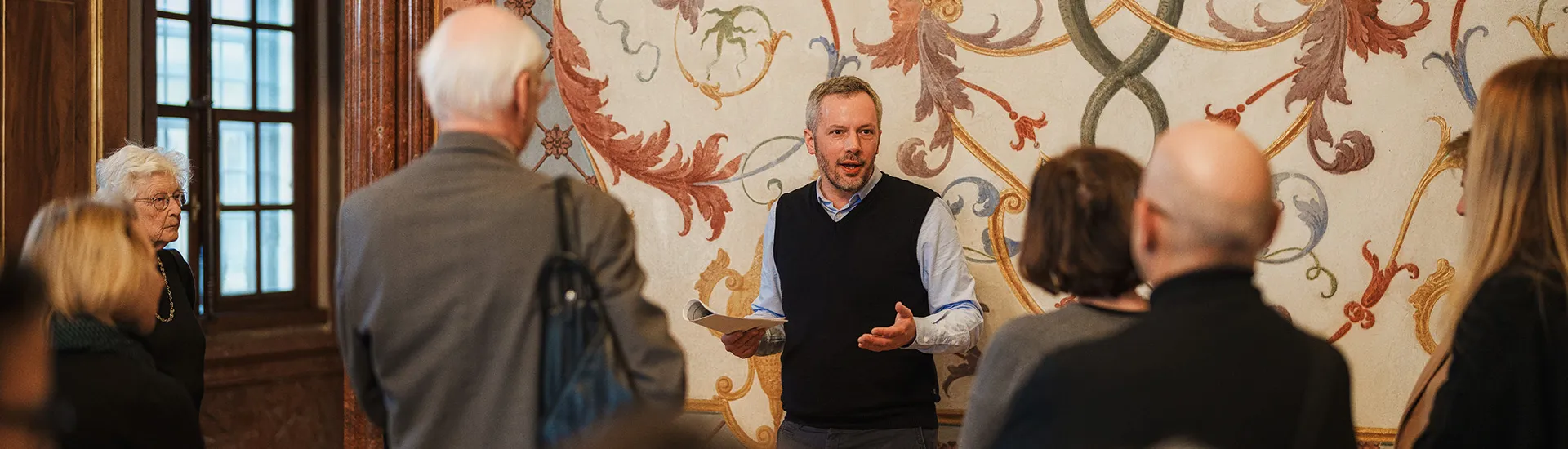
When Georg Lechner talks about art, there are times when he speaks with his whole body. The Belvedere’s resident Baroque specialist delights in his archival dives, where he surfaces with fresh insights—on the painter Franz Anton Maulbertsch, for instance. A meeting with a true aficionado.
Nina Schedlmayer
David Payr
Johannes Stoll
Georg Lechner lowers his chin, juts out his lower lip, and sets his eyes at half-mast. With his arms dangling loosely at his sides, he pushes his belly forward.
That’s how we find him in the Baroque galleries of the museum’s permanent collection. At that moment, the art historian and Belvedere curator isn’t entirely himself, but somewhat resembles Jesus in Franz Anton Maulbertsch’s Christ and the Captain of Capernaum (ca. 1750–55). It’s a spontaneous tableau vivant that drives his point home. Maulbertsch, he explains with characteristic candor, didn’t paint an idealized Christ but a caricature—unkempt, with what he describes as an “almost feeble-minded expression.” That is what sets the painter apart from contemporaries like Johann Michael Rottmayr: this grip on reality.
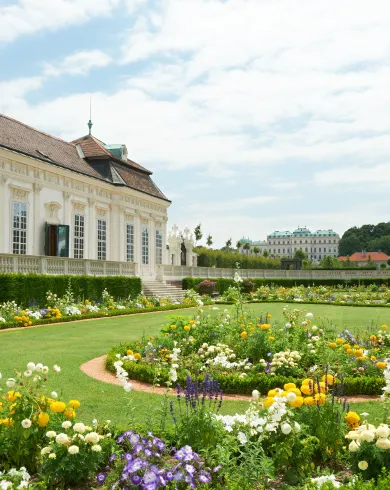
Lechner, as the expert, oversees the Belvedere’s Baroque collection, which includes works by Franz Anton Maulbertsch, Paul Troger, Johann Michael Rottmayr, Johann Kupetzky, Martin van Meytens, Franz Xaver Messerschmidt, Anna Maria Punz, and many more of their contemporaries. His domain also includes “Object Number One,” as he likes to say—the building complex itself. Inquiries of every kind about the Upper and Lower Belvedere—their origins, furnishings, use, or the extensive gardens—inevitably land on his desk, whether it’s a film crew seeking permission to shoot or a particularly knotty research question. Recently, he recalls, someone asked where Kurt Schuschnigg, the last chancellor of Austria’s Austrofascist corporate state, had “lived.” “We know he was interned here during the Nazi period,” Lechner says, “but I couldn’t answer the question in detail.” Such matters can be time-consuming, but this humanities scholar doesn’t mind in the least. On the contrary: “We learn so much!”
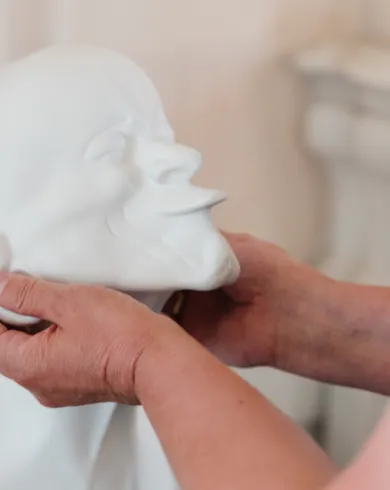
Internationally, the Belvedere is best known for its Klimts and Schieles—or so one would think. But according to Lechner, foreign visitors come not only for the collection itself, “but also for its shell.” And, for Franz Xaver Messerschmidt’s famous “Character Heads.” “They’re a sure-fire hit!” Patrons travel from far and wide to see the distorted faces in which the Baroque sculptor translated states of mind and emotion into forms of expressive caricature. Visitors also expect, Lechner reports, to encounter Prince Eugene himself in a portrait. As the Belvedere’s builder and as a distinguished collector and patron of the arts, the Habsburg general and diplomat now promotes the museum on posters.

And which highlight of the Baroque collection would merit closer attention? Georg Lechner points to Self-Portrait at the Easel by Johann Kupetzky, painted in 1709. Here, the artist presents himself with his painting tools, and, as if he has been momentarily interrupted in his work. “What fascinates me about this picture,” Lechner says, “is its utter spontaneity—as if someone had just opened the door and the painter looked straight at him, all without seeming posed.”
That Lechner would eventually specialize in early art became apparent during his studies at the University of Vienna. At first, however, his focus was on the Late Gothic and Renaissance periods, and in 2005, he submitted his master’s thesis on a work by Lucas Cranach the Elder. Yet the Baroque era also intrigued him. He still speaks enthusiastically about art historian Hellmut Lorenz’s lectures on the Baroque architects Johann Bernhard Fischer von Erlach and Johann Lucas von Hildebrandt. “He taught us to think in terms of the big picture,” Lechner recalls—an ideal foundation for his current portfolio of responsibilities. His doctoral dissertation dealt with the Baroque painter Franz Carl Remp (1675–1718), for which he received, in 2007, the inaugural Bader Prize awarded by the Austrian Academy of Sciences. Before joining the Belvedere, where he has worked since 2009, he completed various internships and traineeships at the Kunsthistorisches Museum Vienna and the Austrian State Archives.
“The older the art, the more challenging it is to put yourself in its time.”
Georg Lechner

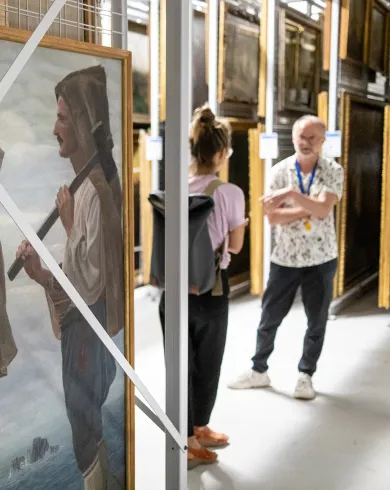
Lechner has developed his expertise over the years through intensive archival research, conversations with collectors, bibliographic study, and, most importantly, through looking, looking, looking. “The older the art, the more challenging it is to put yourself in its time,” he says. “Sometimes I wish I could hear voices from the past.” Getting to know an artist takes real work. Digitization has made some things easier: much archival material is now available online. Almost daily, he finds himself “hanging out” in the Wienerisches Diarium (the predecessor of the Wiener Zeitung), in the Lehmann (an address directory reaching far back in time), combing through cemetery registers, and in digitized death records. He also has building files retrieved from the archives. “It’s always worth looking at old paper,” he says.
The art historian Otto Pächt, one of the patron saints, so to speak, of the University of Vienna’s art history department, once remarked that, to approach early art, one must acquire the unfamiliar ways of seeing of earlier times. This, he wrote, goes beyond a mere “intellectual exercise” and constitutes “a specific re-formation or adaptation of our sensory perception.” The understanding of a work of art, he continued, “depends on the successful maturation of our sensory faculties.” In the case of Georg Lechner, this process appears to be well underway.
Article first published in "Belvedere Kunstmagazin" no. 1-2024.
Gallery